



Key Takeaways
- TaleTok is a faceless YouTube automation platform that can generate scripts, visuals, narration, captions and scheduled YouTube posts from a recurring series setup.
- Its most useful distinction is the choice between one-pass generation and scene-level review. Small businesses should use the review path for any expertise-led episode.
- The product is YouTube-first. Videos can be downloaded for TikTok and Instagram, but the official site says native autoposting is built for YouTube.
- TaleTok can reduce production steps. It cannot verify your claims, choose the right customer question or guarantee audience growth, monetization or inquiries.
- The best first test is one narrow educational series, reviewed by a named human before every scheduled release.
The real decision is not whether you can automate
Faceless YouTube automation is attractive to a small service firm for an obvious reason: the owner can answer recurring buyer questions without recording every week. The difficult part is not generating another video. It is keeping the channel specific enough to sound like the business, accurate enough to protect trust and useful enough to earn the next question from a real prospect.
TaleTok addresses the production side of that problem. Its official site describes a workflow for scripts, AI-generated visuals, voices, captions, series scheduling and YouTube autoposting. It also offers a Quick editor for one-pass output and an Advanced editor for reviewing and regenerating individual scenes. That makes the tool relevant to a small team that wants recurring output but does not want every episode to become a miniature editing project.
The catch is visible in the same product promise. Once a system can generate and schedule episodes repeatedly, weak inputs repeat just as efficiently as strong ones. For an expertise-led business, the safest use is not an anonymous trend channel. It is a narrow question-led series in which the firm supplies the facts, examples and point of view, then a human approves the script and scenes before scheduling.
Direct answer
TaleTok is best considered a production and scheduling layer for faceless YouTube automation. It can turn a selected format and script into short or long-form video, provide scene-level review and schedule YouTube posts. It is a practical fit for a small team running one repeatable educational series. It is a weak fit when the channel depends on original filming, complex demonstrations or unsupervised claims about a regulated or technical service.
What faceless YouTube automation with TaleTok does
The canonical product page identifies TaleTok as a YouTube automation platform. A user chooses a format such as Reddit stories, AI Shorts, 3D shorts or longer Episodes, then generates and schedules videos. The site says Episodes can run up to 10 minutes and scheduled posts can be edited, rescheduled or swapped up to five days before they go live. It also says Quick editor can generate a finished video in one pass, while Advanced editor exposes individual scenes for review and regeneration.
For a business channel, those capabilities translate into a simple job: maintain a recurring, camera-optional explainer series. The product page can supply production structure, but the business still has to supply the approved idea, factual source, script standard and final release decision. That is the difference between automating production and outsourcing judgment.

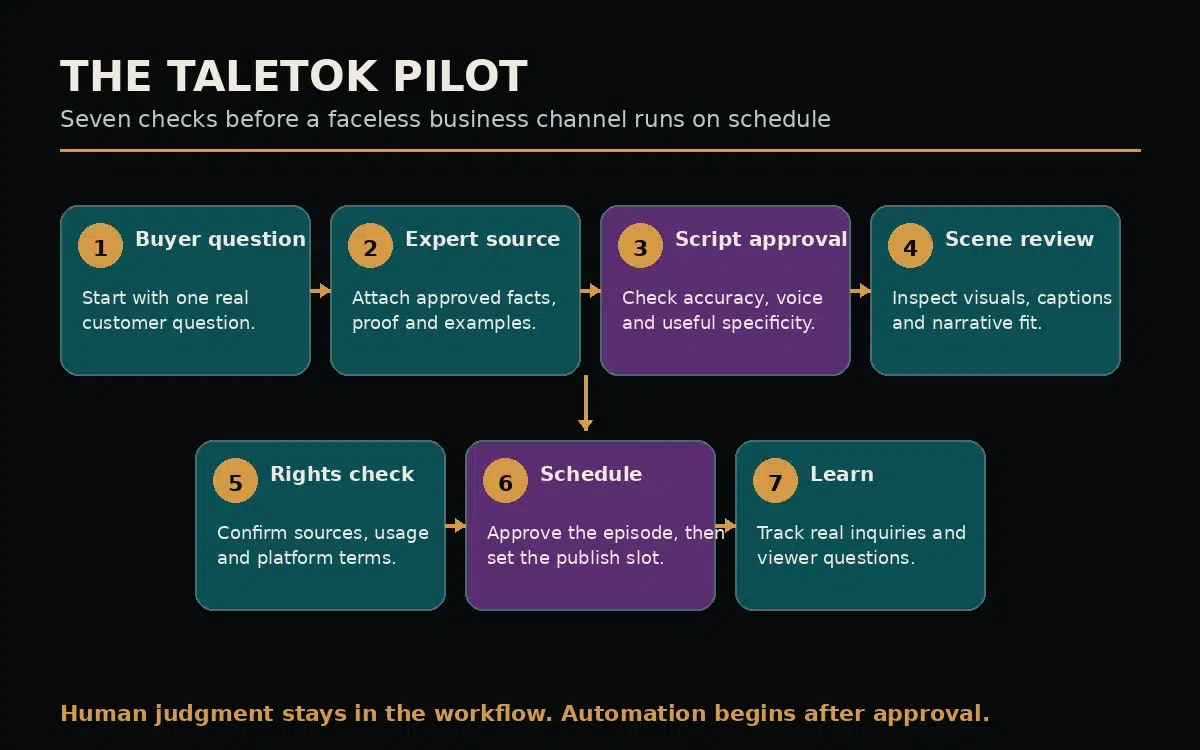
A practical TaleTok pilot keeps human approval between production and publishing.
Seven checks before you automate a faceless business channel
1. Begin with one buyer question, not a trending format
Choose a question that appears in sales calls, support messages or proposals. For an IT services firm, a series might answer one narrow question about onboarding, backups or vendor risk each week. TaleTok supports several formats, but format should follow the question. A recurring question creates continuity; a rotating set of viral styles creates output without a recognizable business story.
2. Attach an approved expert source to every episode
Create a short source packet before a script enters the tool. Include the approved answer, one example, any necessary proof and the sentence the reviewer will not allow the video to overstate. This reduces the chance that an automated script fills uncertainty with generic language. It also gives the reviewer a visible standard instead of asking them to judge accuracy from memory.
3. Approve the script before generating the full video
TaleTok says users can write their own scripts or generate them. An expertise-led firm should keep script approval outside the autopilot. Check the opening promise, technical claims, customer language and final action. The useful question is not whether the script sounds polished. It is whether a prospect could repeat the core answer accurately after watching.
4. Use scene-level review for any trust-sensitive episode
The documented difference between Quick and Advanced editors matters. Quick editor may suit low-risk experiments once the format is stable. Advanced editor is the better default for a business episode because images can imply facts the script never states. Review diagrams, people, devices, locations, captions and any generated visual that could be mistaken for customer evidence or a real product interface.
5. Check rights, source use and platform fit
TaleTok terms say users are responsible for lawful use, platform compliance and rights to included content. The terms also note that the service may use publicly available content such as Reddit material and that users must manage attribution and source compliance. A business should therefore prefer its own script, approved examples and properly licensed inputs. Do not assume that an available format automatically clears the underlying source or style for commercial use.
6. Treat scheduling as a release control
The site documents YouTube autoposting and a five-day window for editing upcoming posts. Use that queue as a review calendar. Assign an owner, require an approved status and keep enough lead time to replace an episode that fails the factual or visual check. The product says TikTok and Instagram videos can be downloaded, while native autoposting is YouTube-first, so plan those other channels as manual distribution unless the product documentation changes.
7. Measure business questions, not vendor monetization promises
TaleTok promotes views, monetization and channel growth on its own pages. Treat those as vendor marketing claims, not expected outcomes. A small service firm should start with signals it can verify: qualified comments, repeat viewer questions, visits to a relevant service page, replies, inquiry quality and whether sales conversations become easier. Automation earns its place only when the series helps the right buyer understand the business.
Pricing and access checked October 1 2026
The official homepage showed a Channel Year view with annual plan prices expressed as monthly equivalents. It also offered two free videos as a quality test. Pricing, credits and benefits can change, so confirm the live checkout before purchase.
|
Plan |
Displayed annual rate |
Credits per month |
Published scheduling fit |
|---|---|---|---|
|
Starter |
$14 USD per month equivalent |
400 |
YouTube autoposting twice weekly |
|
Pro |
$24 USD per month equivalent |
1,200 |
Daily YouTube autoposting |
|
Optimum |
$39 USD per month equivalent |
3,000 |
Daily posting across multiple YouTube channels |
The same page states that annual-plan credits can roll over for up to two months, while monthly credits reset. It lists approximate credit costs by format, so the practical plan depends more on the chosen format than on a simple video count. The page also says the Advanced editor and generation operations consume credits. Confirm the current credit table for the exact format in your pilot.
What stands out and what to watch
|
What stands out |
What to watch |
|---|---|
|
Quick and Advanced editors support both speed and scene review. |
Product and monetization claims come from the vendor, not an independent test. |
|
Series scheduling can remove repeated upload work for YouTube. |
Native autoposting is described as YouTube-first. |
|
The product documents short-form and Episodes up to 10 minutes. |
Credits vary substantially by format and quality setting. |
|
Two free videos create a low-cost way to inspect output quality. |
Terms place content rights and platform compliance on the user. |
|
The queue can be edited several days before release. |
Automated scripts and scenes still require business-specific factual review. |
Who should use TaleTok and who should skip it
Use TaleTok if
- You have one narrow, repeatable educational series with an approved source for every episode.
- You want camera-optional production and accept that human review remains part of the process.
- YouTube is the main scheduled channel and manual distribution elsewhere is acceptable.
- You can assign a named reviewer before each release and track business-relevant signals.
Skip TaleTok if
- Your channel depends on original customer footage, live demonstrations or a presenter whose credibility is the story.
- You need a fully hands-off channel but cannot tolerate factual, rights or brand risk.
- Your primary need is native multi-platform scheduling rather than YouTube-first production.
- You are choosing the tool mainly because of revenue or view claims rather than a defined customer question.
A practical four episode pilot for an expertise-led firm
Choose one buyer question and build four connected episodes. Episode one defines the problem. Episode two shows the common mistake. Episode three walks through a practical decision. Episode four answers the strongest objection. Use the same visual format so the series feels recognizable, but allow the expert source and customer language to shape each script.
Before production, record the source owner, approved claim and desired next question. After generation, review the script, scenes, captions and rights. Schedule only after approval. At the end of four episodes, compare production effort with the quality of viewer questions, relevant site visits and sales conversations. Continue only if the series is making the business easier to understand.
Frequently asked questions
What is faceless YouTube automation?
It is a workflow in which software helps create, schedule and publish YouTube videos without requiring the channel owner to appear on camera. A responsible business workflow still includes human source review and release approval.
What does TaleTok automate?
The official site describes script generation, faceless video production, narration, captions, series scheduling and YouTube autoposting. It also offers one-pass and scene-level editing paths.
Can TaleTok make long-form videos?
The current product page says Episodes and some long-form formats can run up to 10 minutes. Confirm the chosen format, credit cost and live plan limits before committing.
Does TaleTok post to TikTok and Instagram?
The site says videos can be downloaded for those platforms, while native autoposting is built for YouTube. Treat other channels as manual distribution unless current official documentation says otherwise.
Is there a free trial?
The official page says TaleTok offers two free videos. Use them to inspect script quality, scene fidelity, captions and the amount of correction your team needs.
Do TaleTok credits roll over?
The official page says annual-plan credits can roll over for up to two months, while monthly-plan credits reset at renewal.
Does TaleTok guarantee monetization or views?
No verified outcome should be assumed. The product markets monetization and growth possibilities, but audience results depend on topic, quality, originality, distribution and platform decisions.
Who owns videos created with TaleTok?
The homepage says users own the videos they create, while the terms say users remain responsible for included source rights, lawful use and platform compliance. Review current terms for your specific inputs and use case.
Social Scion point of view
A faceless channel should be camera-optional, not human-optional. TaleTok can reduce production and scheduling work, but the part a small business cannot automate is deciding which truth deserves to become the next episode. The strongest workflow begins with a real buyer question, carries approved expertise into the script and keeps a human release decision before the schedule. That is how automation supports a recognizable story instead of becoming a content treadmill.
Want to see the first story your business should tell? Claim a Free Film
Methodology and sources
This is an evidence-based researched review, not a hands-on product test. Product facts and pricing were checked against TaleTok official pages on October 1, 2026. Vendor statements about generation speed, originality, views, monetization and performance are identified as vendor claims rather than independently verified outcomes. No relevant TaleTok listing was found on There's An AI For That during the bounded check, so no substitute review marketplace was used.