


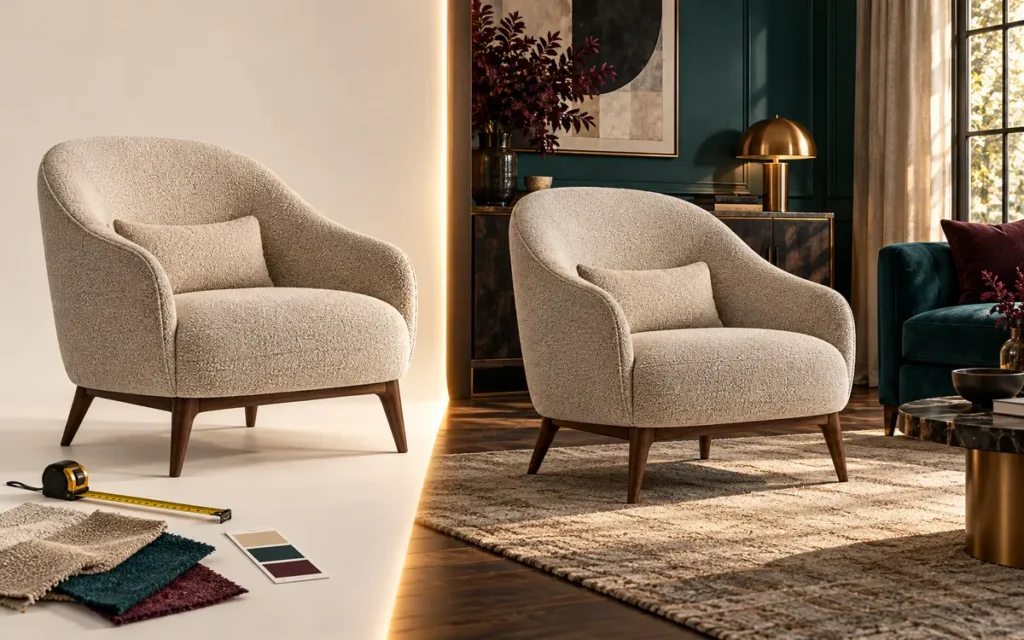
Key Takeaways
- Roominate is built for interior, furniture and home decor brands that want lifestyle images and videos from product imagery.
- It behaves more like an AI product-photography workflow than a general room planner for consumers.
- The strongest buying question is not whether a room looks attractive. It is whether the SKU remains accurate in shape, scale, colour and material.
- The public app confirms product upload, sample-product selection, scene creation and moodboard entry points. Broader capabilities are described on Roominate's own pages and company updates.
- Paid plans are publicly listed, but review effort, token consumption and product correction needs determine the real production cost.
The real problem is not making another beautiful room
Furniture and home decor teams rarely lack ideas for styled rooms. They lack enough believable product scenes for product pages, collections, advertising, email and social content. Traditional photography gives the team control, but every room, angle and seasonal variation adds planning, logistics and cost. A 3D pipeline can create repeatable accuracy, but it requires models, materials and specialist labour.
That makes an interior design generator attractive. Upload a product, place it in a room, try another style, and move faster. Yet speed creates a new review burden. A chair can look persuasive while its seat depth changes. A lamp can feel premium while the shade, finish or scale quietly drifts. The image may sell the atmosphere and misrepresent the SKU.
Roominate is positioned around that exact tension. It is not presented as a generic tool for redesigning a homeowner's room. It is an AI image and video platform for interior brands that want product-led lifestyle content. The decision is therefore practical: can it supplement a real product photography library without making product approval harder?
Direct answer
Roominate is an interior design generator and AI product-photography platform for furniture and home decor brands. Its public app supports product upload, sample-product selection, scene creation and moodboard work. It is best considered for controlled lifestyle-image variation. The main limitation is unproven SKU fidelity without a hands-on test, so product, rights and review checks still sit with the brand.
What the Roominate interior design generator does
The Roominate public app presents a product-first workflow. A user can select or upload a product, work with product or scene views, create a moodboard and generate lifestyle imagery. The visible sample catalogue includes sofas, chairs, beds, bedside tables, coffee tables, lamps, cushions, bookshelves, radiators, taps and tiles.
Roominate's official site and company updates describe a broader production system: AI lifestyle imagery and video, precision editing, collaboration, catalogue handling, Shopify connections, publishing and analytics. Those are vendor-described capabilities, not results independently tested for this review. The distinction matters. The accessible app proves the basic product-to-scene workflow. It does not prove that every output will preserve exact dimensions, materials or colour.
For a small interior brand, the useful promise is simple. One approved product image can become several contextual assets without rebuilding a physical set for every campaign. The approval standard should remain equally simple: the room may be generated, but the product cannot become fictional.
Six Roominate fidelity checks before you publish
1. Lock the source product before you prompt the room
Begin with the cleanest approved SKU image available. Keep dimensions, colour references, finish, fabric name, leg profile and distinctive construction details beside it. If the product has modular pieces, multiple variants or optional accessories, define exactly which configuration the scene must show.
This matters because a generator can create a visually coherent object that is no longer the same object. A reviewer needs a fixed source to compare against, not a memory of the catalogue photo. Use one hero angle first. Add harder angles only after the tool passes the basic fidelity check.
2. Test silhouette and scale before judging style
The first review should ignore whether the room feels luxurious. Compare the outer shape, seat height, back curve, arm width, leg spacing and overall proportion. Then inspect scale against recognizable objects such as a door, table, rug, outlet or person when a person is appropriate.
A believable room is not evidence of an accurate product. If a dining chair grows into a lounge chair or a pendant shrinks against a ceiling, the image has failed even when the lighting is excellent. Reject geometry drift before spending time on colour grading or campaign fit.
3. Inspect materials, colour and reflections
Soft goods and reflective products create different failure modes. Fabric can lose its weave, timber grain can change direction, metal can acquire the wrong finish, and glass can become opaque. Check seams, texture density, edge highlights and shadow behaviour against the real item.
Use approved material swatches and colour references as review aids. Do not assume a pleasant screen colour is faithful. The tool's own updates emphasize product accuracy and improved material rendering, but a brand still needs a human approver who knows the SKU.
4. Choose a room that answers a buyer question
A generated scene should do more than decorate a product. It should help a buyer understand fit, use or atmosphere. A compact sofa might need a small-city-apartment scene. An outdoor chair needs credible weather, floor and scale context. A tap needs a basin and counter that make installation logic understandable.
This is where Roominate can earn a place in the content system. A product page needs clarity. An ad may need aspiration. A seasonal email may need an atmosphere. Use the same product truth, but brief the scene for the job. The product page should not inherit the exaggeration of a campaign image.
5. Count the correction and approval effort
Generation time is only one part of production time. Track how many scenes are rejected, what types of defects recur, whether corrections require a full regeneration, and how long product, brand and legal reviewers spend on each asset.
Roominate says its workflow includes precision editing and team collaboration. Those capabilities may reduce review friction, but the business case depends on the specific catalogue. A simple upholstered chair may pass quickly. A patterned textile, mirror, tile repeat or technical fitting may demand more correction. The right metric is not images generated. It is approved assets per reviewer hour.
6. Confirm rights, plan limits and a low-risk first use
Roominate's official pages state that paid plans include commercial usage rights for websites, catalogues, ads and packaging. The brand should still read the current plan terms before publishing, especially when outputs include third-party interiors, reference images or recognizable design elements.
Start with a low-risk placement such as a secondary gallery image, organic social post or concept email. Keep the original product photo visible nearby. Do not begin with the main ecommerce hero image, a regulated claim or packaging. A small test reveals whether the workflow saves time without asking customers to trust an inaccurate product.

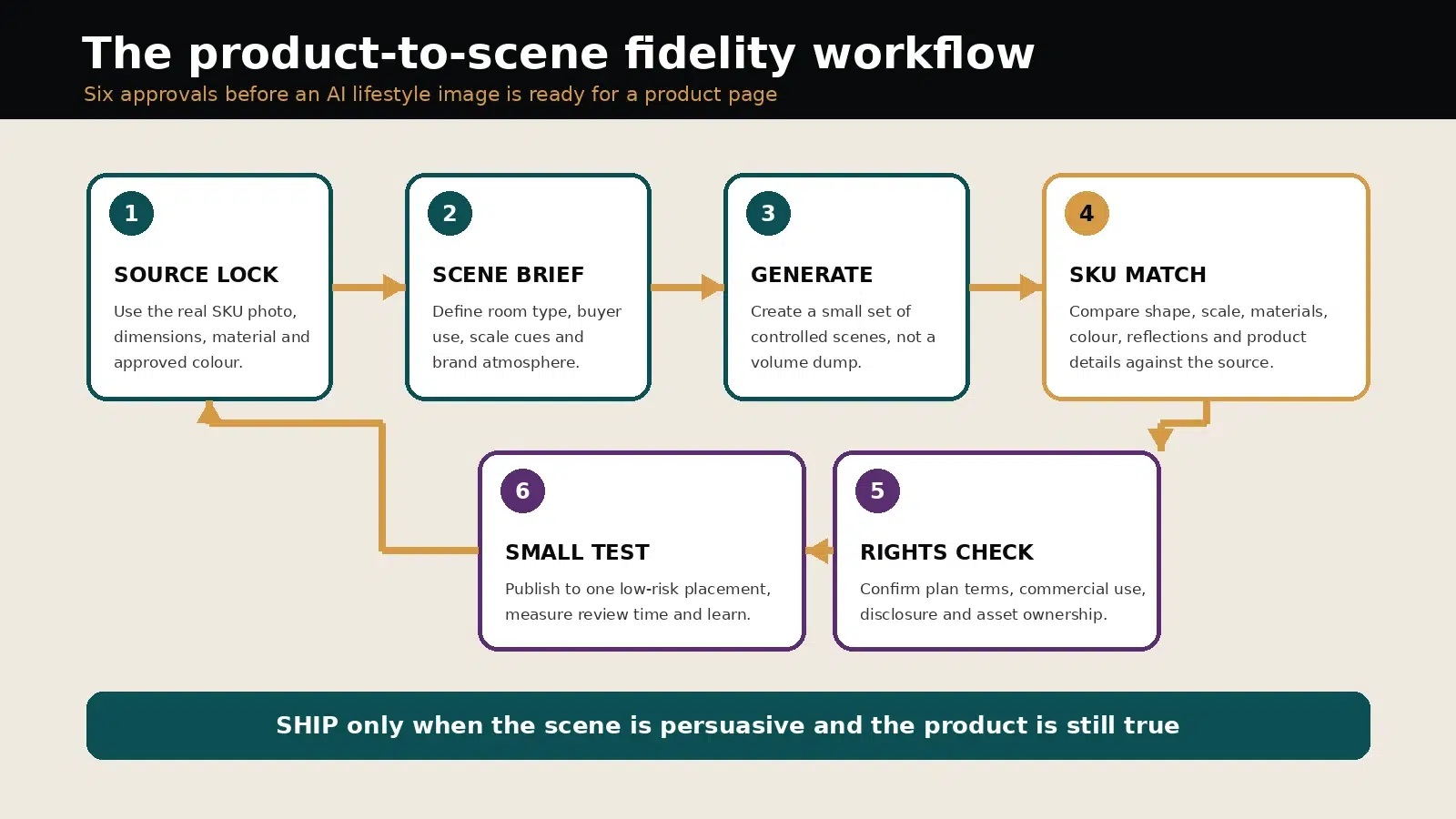
Figure 1. The product-to-scene fidelity workflow turns an attractive generation into an approvable product asset.
Roominate pricing and access
Roominate's official pricing page lists annual plans and promotes a free start. The public page also markets imagery from $0.75 per image. Because the site uses tokens, the actual cost per approved asset depends on the action mix, reruns and corrections.
|
Annual plan |
Listed price |
Included tokens |
Decision note |
|---|---|---|---|
|
Essential |
$129 USD per year |
2,400 |
A small controlled test for a limited catalogue. |
|
Studio |
$549 USD per year |
12,000 |
More production room for recurring campaigns. |
|
Pro |
$1,499 USD per year |
36,000 |
Higher-volume teams should validate approval throughput first. |
Verify current pricing on the official Roominate pricing page before purchase.
What stands out and what to watch
|
What stands out |
What to watch |
|---|---|
|
Product-first workflow for furniture and home decor rather than generic room redesign. |
No hands-on output was produced for this review, so exact SKU fidelity is not independently proven. |
|
Visible product upload, sample catalogue, product and scene views, and moodboard entry point. |
Root site, features and pricing pages returned 403 to direct fetch despite appearing in current official search results. |
|
Vendor-described precision editing, collaboration, Shopify catalogue sync, publishing and analytics. |
Those broader capabilities were verified from official company material, not from an authenticated product test. |
|
Paid-plan commercial-use language is publicly stated. |
Terms, token use and correction effort should be confirmed for the selected plan and workflow. |
Use Roominate if
- You market furniture, lighting, home decor, surfaces or interior products and need more lifestyle variations.
- You already have approved SKU photography, dimensions and material references.
- You can assign a product owner to approve every generated scene.
- You want to test secondary ecommerce, campaign, email or social assets before replacing core photography.
Skip Roominate for now if
- You need legally or technically exact imagery without a human product review.
- You have no clean source photography or reliable product specifications.
- Your catalogue depends on intricate patterns, transparent materials or installation details that have not passed a sample test.
- You expect the tool to replace art direction, merchandising decisions or product truth.
Roominate versus real photography and 3D rendering
|
Route |
Best when |
Main watchout |
|---|---|---|
|
Real product photography |
The primary hero image, regulated detail and exact material representation matter most. |
Sets, locations and repeated variations increase production burden. |
|
3D rendering |
A reusable geometry and material pipeline must support many precise angles or configurations. |
Model creation, material setup and specialist workflow can be expensive. |
|
Roominate AI lifestyle scenes |
A team needs fast contextual variations from approved product inputs. |
Every scene needs SKU-fidelity, rights and review checks. |
A practical small-business test
Imagine a Toronto furniture retailer launching one boucle lounge chair in three campaign settings. The team keeps its approved studio photo as the source of truth. It briefs one compact condo scene, one quiet reading corner and one seasonal living room. Each scene must preserve the same curve, leg finish, cushion shape, texture and dimensions.
The merchandiser rejects any scene that changes the chair. The brand lead reviews atmosphere and campaign fit. The ecommerce lead checks that generated context does not replace the main product image. The team publishes one approved scene as a secondary product-gallery asset and records reviewer time, rejection reasons and customer questions.
If the asset reduces location-shoot demand without increasing correction work or customer confusion, the workflow can expand. If product drift persists, Roominate remains a concepting tool rather than a final-asset tool. That is a useful conclusion too.
Frequently asked questions
What is the Roominate interior design generator?
Roominate is an AI image and video platform for interior, furniture and home decor brands. It turns product inputs into lifestyle scenes and related marketing visuals.
Is Roominate a general room planner?
Its positioning is product photography for interior brands, not consumer room planning. The workflow starts with products and scenes rather than a full architectural design brief.
Can Roominate preserve exact furniture details?
Roominate emphasizes product accuracy, precision editing and material rendering in its official material. This review did not perform a hands-on output test, so every brand should validate its own SKU.
Does Roominate have a free plan or trial?
The official site promotes getting started free. Confirm the current access terms and export limits inside the product before beginning a catalogue test.
How much does Roominate cost?
The official pricing page lists annual Essential, Studio and Pro plans at $129, $549 and $1,499 USD, with 2,400, 12,000 and 36,000 tokens respectively, as checked on Sep 29, 2026.
Can Roominate images be used commercially?
Roominate's official about page states that paid plans include commercial usage rights for websites, catalogues, ads and packaging. Review the current terms for your plan and inputs.
What should I test first?
Use one clean SKU with known dimensions and materials. Generate a small number of scenes, compare every output against the source, then publish one low-risk secondary asset.
What is Roominate's main limitation?
The decision depends on product fidelity and review effort. An attractive room is not enough if the product changes or needs repeated correction.
Social Scion stance
Roominate is most useful when it expands a product's story without rewriting the product. The real SKU, measurements, materials and buyer context lead. AI supplies staging options. Human judgment decides which scene is true enough to ship.
A product image can attract attention. A believable product story helps the buyer trust what they see. For the broader approach, read Why Visual Storytelling Is the Real Growth Lever for Small Business and AI Video Limitations in 2026.
Want to see what your business looks like when the right story is found first? Get your Free Film.
Methodology and sources
Methodology: EVIDENCE-BASED RESEARCHED. This review uses the approved AIOS Tool Queue brief, Roominate's accessible public app, official Roominate pages indexed on the research date, and the company's supplied LinkedIn page. No hands-on product test is claimed. No relevant There's An AI For That listing was found, and no substitute review marketplace was used.