


Key Takeaways
|
|---|
Figure 1. Seven rules for using AI as a storytelling partner without handing it ownership of the story.
Storytelling AI Is Moving From Prompting Toward a Creative Workflow
The most useful AI storytelling changes in September are not about a model writing a better opening line.
They are about how creative teams make decisions before production.
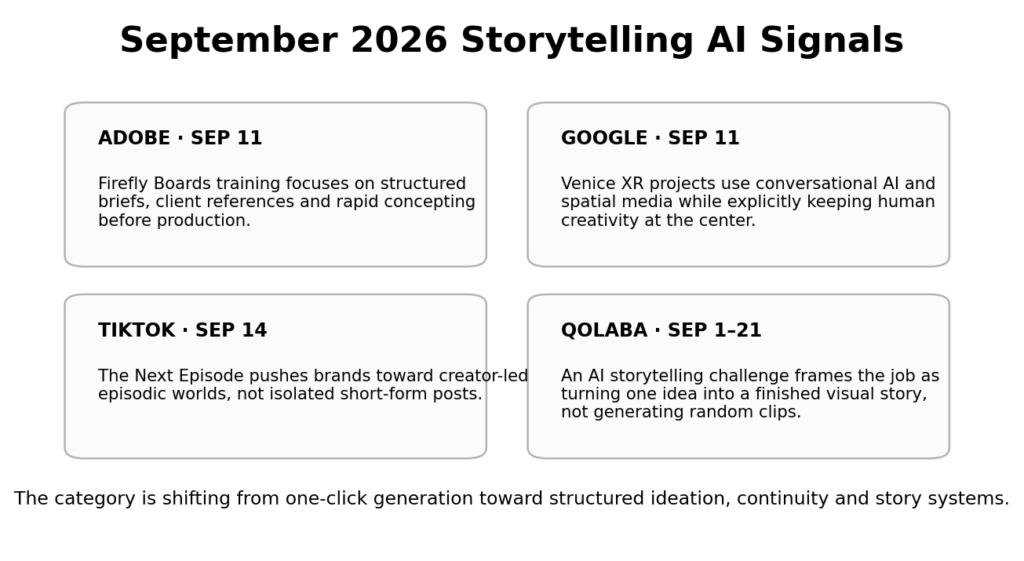
On September 11, Adobe published a Firefly Boards workflow for rapid concepting. The lesson begins with client photographs and a structured prompt formula, then uses AI to explore several visual directions inside one board. The important part is the order: source material first, expansion second, selection after.
Adobe’s related commercial storyboard workflow uses style and character references to keep storyboard panels coherent, then animates a frame to test camera movement before full production.
Google is making a similar argument from a different medium. Three Google-supported projects premiered during the 2026 Venice Film Festival using conversational AI, spatial media and XR, while Google explicitly described the goal as expanding the storytelling canvas while keeping human creativity at the center.
Then TikTok pushed the idea into branded entertainment. The Next Episode is designed around creator-led micro-dramas, interviews, game shows, docuseries and reality formats. The platform is encouraging brands to build recurring worlds and formats instead of treating every post as a separate prompt.
Taken together, these are not one-click storytelling products.
They are evidence that AI is moving deeper into the story room.
The strategic question becomes: which decisions should AI expand, and which decisions should remain human?
Figure 2. September 2026 signals show AI storytelling becoming more structured, reference-led and workflow-oriented.
What Is Storytelling AI?
Storytelling AI is the use of artificial intelligence to help discover, structure, visualize, produce, edit or adapt a story while human judgment remains responsible for the source truth, point of view, evidence and final meaning.
The term is useful because it focuses on the role AI plays inside the storytelling process rather than treating AI as the author by default.
Storytelling AI vs. AI storytelling
The two phrases overlap, but they can answer different search intent. AI storytelling often asks what AI-assisted storytelling is and how trust survives the technology. Storytelling AI is more naturally a workflow question: where can AI help inside research, story development, storyboarding, generation, editing and repurposing?
Storytelling AI vs. AI writing
AI writing usually focuses on language output. Storytelling AI can work before the script and after it. It can map interview themes, compare story structures, generate storyboard frames, test visual references, organize a rough cut or adapt one approved story into several media formats.
Storytelling AI vs. AI video generation
Video generation produces footage. Storytelling AI decides what work should happen around that footage. A beautiful generated scene is useful only when it belongs to a clear story decision.
The Human + AI Story Room
A healthy storytelling AI workflow alternates between expansion and decision.
AI expands the possibility space. Humans narrow it.
Figure 3. The productive handoff alternates between human source, AI expansion, human choice, AI execution and human review.
1. Human Source: collect what actually exists
Start with interviews, customer language, reviews, product facts, founder notes, process detail, archive or current research. The source should exist before the model is asked to make the story interesting.
2. AI Map: surface patterns and possibilities
Ask AI to identify repeated tensions, contradictions, missing context, possible arcs and questions. This is analysis, not final storytelling.
3. Human Choice: decide what this story is really about
Select the point of view, promise, central tension and meaning. A model can propose ten directions. Only a human close to the business can decide which one is both true and strategically useful.
4. AI Build: visualize approved directions
Generate storyboard panels, scene options, reference frames, alternate hooks, camera concepts or rough narration from the approved story spine.
5. Human Edit: create cause and effect
Decide what the audience learns in each beat, what evidence must appear, what should be cut and what the ending means.
6. AI Adapt: scale the approved story
Turn the final source into shorter videos, alternate formats, captions, email versions, translations or supporting visuals without changing the underlying claim.
|
The story room rule Let AI create more possibilities. Keep the final story decision attached to a human point of view. |
Define Decision Rights Before You Add More AI
Most weak AI storytelling is not caused by a bad model.
It is caused by unclear responsibility.
The team asks the model to ‘make this more emotional’ or ‘find a better story’ without first deciding who owns the truth, proof and final point of view.
Figure 4. A simple decision-rights model for human and AI roles in storytelling.
The division is not anti-AI.
It is what makes AI useful.
A system becomes faster when nobody has to debate whether the model is allowed to invent a quote, change the promise, rewrite a customer result or decide the emotional meaning of the ending.
7 Rules for Using Storytelling AI Without Losing the Story
1. Start With Source Material the Model Did Not Invent
Customer calls, founder interviews, product behavior, reviews and operating details give AI something specific to work with. Without that source, the system defaults toward patterns it has seen before.
2. Ask AI to Map Before You Ask It to Write
Use the first pass to extract tensions, questions, proof and possible arcs. Mapping helps expose what the source contains before polished copy hides the gaps.
3. Force Divergence Before Selection
Ask for several structurally different directions, not seven rewrites of the same idea. One may be customer-led, one founder-led, one product-led, one reverse chronological and one built around a recurring object. Diversity is the value of the machine at this stage.
4. Make the Human Choice Before Visual Generation
Visual generation is seductive. A beautiful frame can make a weak story direction feel stronger than it is. Lock the point of view, central change and proof before generating expensive or detailed scenes.
5. Use References to Preserve Story Continuity
Reference images, approved visual rules, locations, wardrobe, products and recurring objects reduce drift. Adobe Firefly Boards and modern video tools increasingly support this reference-led approach because storytelling exposes inconsistency faster than one-shot generation.
6. Edit for Causality, Not Output Quality
The edit should answer why this beat follows the previous one. Remove a generated shot if it adds beauty but no new information, pressure, proof or meaning.
7. Adapt Only After the Canonical Story Is Approved
Once the story is verified, AI can create shorter videos, social variants, emails, article summaries and translations. Adapt depth and format, not the truth.
Current Example: AI Can Expand the Story World Without Becoming the Story
Google’s Venice XR work is a useful example because conversational AI is inside the audience experience rather than replacing the filmmaker’s central idea.
One project uses Gemini-powered conversations inside an animated mixed-reality story. Another uses an AI-driven digital Charles Darwin inside an immersive nature experience.
The AI capability changes how the audience can interact with the world.
It does not remove the need for authored characters, environments, themes and narrative intent.
The same principle applies to a small business.
A real-estate firm can use AI to visualize an unavailable future renovation. A jeweler can storyboard the life of a custom piece before production. A founder can turn an interview into several possible narrative structures. A product brand can prototype three visual metaphors before choosing one.
In each case, AI expands the possibility space.
The business still decides what the story means.
Why the New AI Storytelling Challenges Matter
Emerging creative platforms are increasingly framing the job around narrative rather than generation.
For example, Qolaba’s September AI Storytelling Challenge asks creators to turn one idea into a visual story, scene, monologue or potential episode. The challenge runs through September 21.
This is an emerging-platform example rather than mature market evidence, but the framing is useful.
The unit of value is not the prompt.
It is the finished story.
3 Tools for a Practical Storytelling AI Workflow
These tools solve different stages of the story room. Adobe Firefly Boards is strongest for visual ideation and reference-led concepting. Boords is strongest for script-to-storyboard planning and approval. Descript is strongest when the story already exists in spoken media and needs to be shaped through the edit.
|
Tool |
Best story-room job |
Current pricing |
Independent signal |
Strength |
Tradeoff |
|
Adobe Firefly Boards |
Visual ideation, moodboards, references and storyboard exploration |
Firefly Standard $9.99/month; Boards included with unlimited access on current paid plans |
No mature standalone G2 signal used |
Fast concept expansion from real references, storyboard panels and connection to Firefly generation |
Easy to overvalue attractive concepts before the story choice is settled |
|
Boords |
Turn approved story structure into storyboard, script and review workflow |
Solo $39 monthly or $26 annual; Pro $75 monthly or $50 annual |
G2 4.7/5 · 27 reviews |
Scripts, storyboards, AI frames, comments, versions and client sign-off |
More useful for recurring pre-production than occasional one-person projects |
|
Descript |
Find, edit and repurpose the story inside interviews and spoken video |
Free; Hobbyist $16 annual or $24 monthly; Creator $24 annual or $35 monthly |
G2 4.6/5 · 921 reviews |
Transcript-led editing, clips, captions, Underlord and direct access to exact human language |
Not a replacement for deep cinematic pre-production or complex storyboard design |
Adobe Firefly Boards: best for visual divergence
Firefly Boards is useful when the team needs to explore visual directions before choosing a production path.
Adobe’s current Firefly plans list Standard at $9.99 per month with 2,000 generative credits, Pro at $19.99 with 4,000 credits and higher tiers for heavier video use. Current plans include unlimited access to Firefly Boards.
Social Scion assessment: use Boards to widen the option set. Do not confuse the most attractive moodboard with the strongest story.
Boords: best for making the story explicit before production
Boords creates a useful forcing function: every scene needs a place in a sequence.
Its current pricing lists Solo at $39 monthly or $26 with annual billing, and Pro at $75 monthly or $50 annually.
The Boords G2 profile currently shows 4.7/5 across 27 reviews. Recent reviewers repeatedly mention speed, visual planning and the ability to organize scripts and scenes in one place.
Social Scion assessment: use Boords when the story is approved but the sequence still needs to survive team or client review.
Descript: best when the human story is already recorded
Descript is valuable when the source is an interview, podcast, webinar or founder recording.
Its current pricing lists Hobbyist at $16 per person per month with annual billing and Creator at $24 annually. The paid plans include media hours, AI credits, Underlord and broader video-generation and editing tools.
The Descript G2 seller profile currently shows 4.6/5 across 921 reviews.
Social Scion assessment: use Descript to preserve the exact human sentence that changes the story rather than paraphrasing every interview into generic narration.
The Myth: Better Prompts Create Better Stories
Better prompts can create more controlled output.
They do not automatically create a better story.
A detailed prompt can specify lens, light, composition, emotion and camera movement while still avoiding the central question: why should this moment exist?
Prompt quality improves execution.
Story quality comes from source, tension, consequence, proof and point of view.
The strongest prompt is often downstream of the stronger question.
Example: A B2B Founder Uses Storytelling AI Without Sounding Generated
Imagine a small IT services firm records a 45-minute founder conversation about why clients call only after a small technology problem becomes an expensive operational issue.
A weak workflow asks AI to write a thought-leadership video about proactive IT.
A stronger workflow separates the jobs:
- Human source: keep the founder’s actual examples and language.
- AI map: identify repeated tensions, such as invisible risk, delayed action and the cost of waiting.
- AI diverge: propose a customer-story structure, founder-point-of-view structure and reverse-chronology structure.
- Human choice: select the structure that best reflects how clients actually behave.
- AI visualize: build storyboard options around one incident without inventing client facts.
- Human edit: keep the sequence that makes the consequence clear and remove decorative scenes.
- AI adapt: turn the approved story into a 60-second video, a 20-second clip, an email opening and a website FAQ answer.
AI has contributed at nearly every stage.
The business still owns the story.
How to Build a Storytelling AI Workflow in 9 Steps
1. Collect one real source
Choose an interview, customer conversation, review pattern, product truth or current issue connected to the business.
2. Mark facts and direct language
Separate what happened from interpretation. Preserve unusual phrases and details.
3. Ask AI to map tensions and gaps
Do not request polished copy yet. Find the material inside the source.
4. Generate several story structures
Force differences in point of view, order, protagonist and creative device.
5. Make the human story choice
Choose the direction that is both true and useful for the audience.
6. Storyboard or outline the approved structure
Assign a purpose to every beat before visual production.
7. Use AI to visualize and prototype
Generate references, rough frames, alternate hooks and hard-to-film moments.
8. Edit with evidence visible
Check that the proof appears where the story needs belief, not only at the end.
9. Adapt the approved story
Scale into shorter videos, email, social or written answers without reopening the underlying truth.
Practical Prompt: Use AI as a Story Room, Not a Ghostwriter
|
Map first, choose second, write third Act as a story-room assistant using only the verified source below. PHASE 1: MAP PHASE 2: DIVERGE For each direction provide: PHASE 3: STOP Ask the human to choose one direction. Do not invent quotes, results, chronology, customer emotions, founder history, product capabilities or evidence. If information is missing, mark it [NEEDS SOURCE]. Verified source: [paste source]. |
When Should a Small Business Pay for Storytelling AI Tools?
Pay when the AI tool removes a repeated bottleneck in a story process the business already understands.
- Interviews or customer conversations repeatedly need to be mapped into themes and story options.
- Storyboarding is preventing expensive production mistakes.
- Visual concepting needs several options before the team commits to filming or generation.
- Spoken content regularly needs clips, captions and shorter story versions.
- The same approved story needs to move across several formats without constant rewriting.
Do not add a storytelling AI tool because it can generate more.
Add it when it improves a specific handoff between source, choice and production.
Common Storytelling AI Mistakes
Asking for the final story too early
The first polished draft can hide gaps in source material and lock the team into the first plausible structure.
Letting AI choose the point of view by default
A neutral model often flattens the very opinion or tension that makes the story distinctive.
Generating visuals before choosing the story
Attractive images create attachment to directions that may not deserve production.
Confusing variation with originality
Ten similar hooks are not ten story directions.
Letting AI rewrite direct customer language
The unusual phrase is often the most valuable human signal in the source.
Using the model to fill missing proof
A plausible detail is still invented evidence.
Skipping the human edit
Generated sequences tend to keep too much. Meaning often appears when unnecessary material is removed.
Repurposing before approval
Scaling an unstable story multiplies confusion faster.
FAQ: Storytelling AI in 2026
What is storytelling AI?
Storytelling AI is the use of artificial intelligence to help discover, structure, visualize, produce, edit or adapt stories while humans remain responsible for truth, proof, point of view and final meaning.
How is storytelling AI different from AI storytelling?
They overlap. Storytelling AI is especially useful as a workflow term for the tools and handoffs inside story development, while AI storytelling often describes the broader practice and trust implications.
Can AI find a story inside an interview?
Yes. AI can map recurring themes, tensions, quotes and possible arcs. A human should decide which interpretation is accurate and worth developing.
Can AI create storyboards?
Yes. Adobe Firefly Boards and Boords both support AI-assisted visual planning and storyboarding.
Should AI write the final script?
AI can draft from an approved structure, but a human should verify the source, point of view, proof, tone and meaning before production.
What is the best storytelling AI tool?
There is no single best tool. Firefly Boards is strong for visual ideation, Boords for pre-production sequencing and Descript for shaping stories from recorded speech.
Can storytelling AI help small businesses?
Yes. It can reduce time spent organizing founder knowledge, customer language and product proof into repeatable story formats.
How do I stop AI stories from sounding generic?
Use source material the model did not invent, preserve direct language, force structurally different options and make a human choose the final point of view.
Should I use AI before or after the brief?
Use AI during research and mapping if useful, but lock the human story decision before expensive visual production.
What should never be delegated to storytelling AI?
Customer truth, consent, factual proof, founder history, final claim approval and responsibility for what the story means should remain human-controlled.
The 2026 Stance: The Best Storytelling AI Creates More Choices, Not Less Responsibility
AI is becoming better at concepting, storyboarding, scene generation, editing and adaptation.
That makes the story room faster.
It does not remove the need for authorship.
The useful future is not a model that decides what your business should mean.
It is a system that helps humans see more possible structures, test more visual directions and carry one approved story further without losing the truth that made it worth telling.
AI expands the room.
Human judgment chooses the story.
Your Business Already Has Better Source Material Than a Blank Prompt
The raw story may already be inside a customer phrase, founder interview, product decision, repeated objection or piece of proof.
Social Scion AI starts with that source, then uses human creative intelligence and AI production to turn it into a story people can understand, feel and act on.
|
Get your Free Film See what happens when AI enters the story room after the real source is found. Claim the Free Film Story that attracts. System that converts. |