


Key Takeaways
| Synthetic AI video is no longer one format. It includes digital twins, stock AI presenters, generated scenes, voice cloning, translation, synthetic B-roll, and AI-assisted edits applied to real footage. In YouTube CEO Neal Mohan’s 2026 letter, YouTube said more than 1 million channels used its AI creation tools daily in December. Synthetic production is moving into normal creator workflows, not staying at the edge of experimentation. Realistic synthetic content carries a different trust burden from stylized or clearly fictional content. YouTube requires disclosure when realistic AI meaningfully changes a person, place, event, or scene, and can use C2PA metadata or internal detection to apply labels automatically. The safest production rule is simple: let AI replace production friction, not business truth. A synthetic presenter can deliver a verified message. A synthetic customer quote, fake result, or invented event is a different category of risk. Synthesia, HeyGen, and Colossyan all produce synthetic presenter video, but they are built for different jobs. Tool choice should follow the communication problem, not avatar realism alone. |
|---|
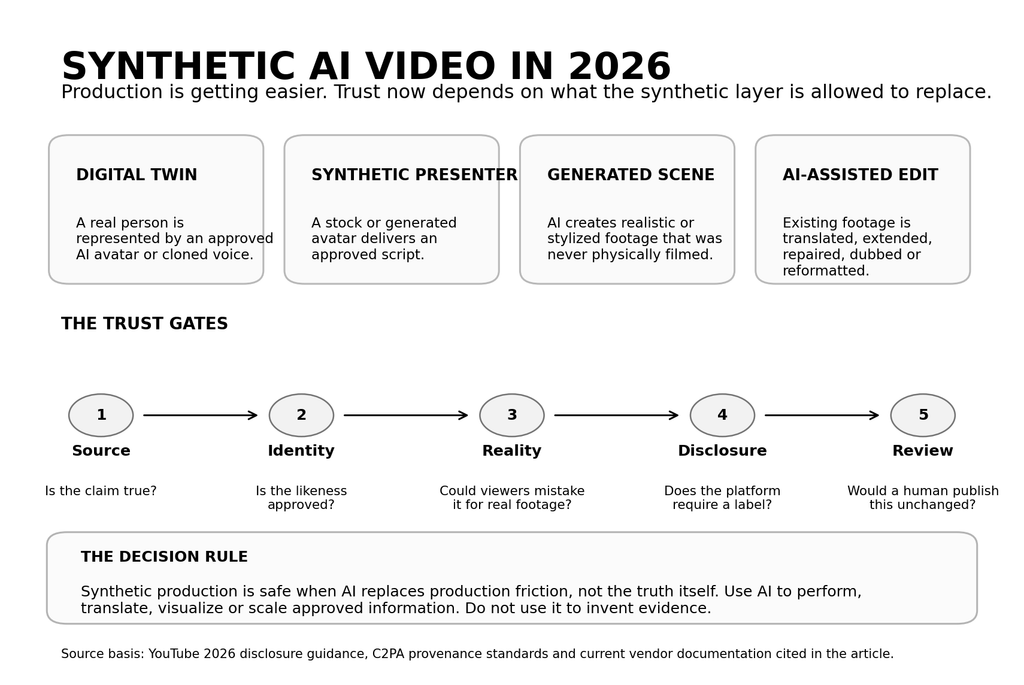
Figure 1. Synthetic AI video in 2026: four production modes and the five trust questions to answer before publishing.

Synthetic AI Video Is Becoming Ordinary Production
The most important change in synthetic AI video is not that the faces look more realistic. It is that the workflow is becoming ordinary.
A small business can now turn an approved script into a presenter video, translate the same speaker into multiple languages, animate a still photograph, create a digital twin, extend a background, generate B-roll, or build a scene that never existed physically. None of those jobs automatically requires a camera day.
YouTube’s own 2026 direction shows how quickly AI production is normalizing. In YouTube CEO Neal Mohan’s 2026 letter, the platform said more than 1 million channels used YouTube AI creation tools daily in December. YouTube is expanding those tools while also making AI transparency and likeness protection a stated priority.
That combination matters. The market is not moving toward “AI video or real video.” It is moving toward a blended production environment where some parts of a video are captured, some are generated, some are cloned, some are translated, and some are edited by AI.
For a business owner, that means the production question changes from “Is this AI?” to “Which part is synthetic, why is it synthetic, and does that change what the viewer should believe?”
Social Scion already treats AI video production this way on its Humanized AI Storytelling Systems page: cinematic stories, avatar stories, UGC proof stories, product animation and authority clips are different formats for different business jobs. The format is selected after the story, not before it.
What Is Synthetic AI Video?
Synthetic AI video is video in which artificial intelligence creates, replaces, or materially transforms visual or audio elements that would traditionally have been captured from a physical person, place, object, voice, or event.
That definition is broader than “deepfake.” Most business use is not deceptive impersonation. It is production substitution: a digital twin replaces repeated recording, a synthetic presenter replaces a studio spokesperson, generated B-roll replaces a location shoot, or AI dubbing replaces a second-language recording session.
The important distinction is between the production layer and the evidence layer. A synthetic presenter can communicate a true product policy. A generated room can illustrate a future design concept. A cloned founder voice can deliver a script the founder approved. In each case, the delivery mechanism is synthetic while the source truth remains human and verifiable.
Four common types of synthetic AI video
| Type | What AI replaces | Good business use | Trust question |
|---|---|---|---|
| Digital twin | Repeated performance by a real person | Founder updates, training, multilingual explainers | Did the person approve the likeness, voice and script? |
| Synthetic presenter | A filmed spokesperson | FAQ, onboarding, product education, internal communication | Could viewers mistake the presenter for a real employee or customer? |
| Generated scene | Physical filming of a place, event or visual moment | Concept films, product visualization, abstract storytelling | Could the scene be mistaken for something that actually happened? |
| AI-assisted edit | Manual editing or rerecording | Translation, dubbing, background extension, repair, reframing | Did the edit materially change what the original footage means? |
The Synthetic Video Trust Gate
Production quality is no longer enough to judge synthetic AI video. Before a synthetic asset is published, it should pass six gates that separate useful production automation from avoidable trust problems.
Figure 2. The Synthetic Video Trust Gate: source, consent, reality, disclosure, human review and publication all belong in the production workflow.

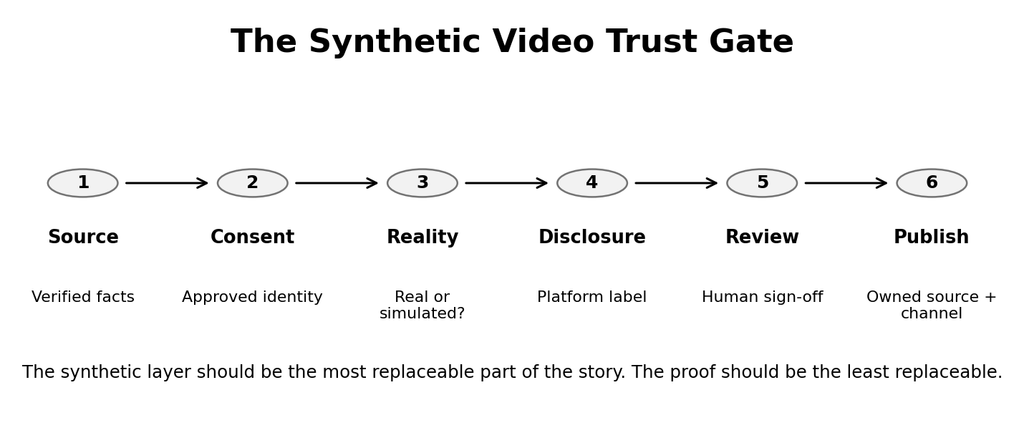
1. Source: Is the message verified?
Lock the script, product claim, customer result, price, policy, statistic, quote and business fact before generation. The synthetic layer should not be the place where missing evidence gets filled in.
2. Consent: Is every identifiable likeness or voice approved?
If the video uses a founder, employee, customer, actor or other real person as a digital twin or cloned voice, document permission for the specific use. A technically convincing avatar is not a substitute for consent.
3. Reality: Could a reasonable viewer mistake the scene for something that happened?
A stylized concept film and a photorealistic simulation create different expectations. The more realistic the synthetic scene, especially when it depicts a real person, place or event, the more carefully the production should handle context and disclosure.
4. Disclosure: Does the channel require a label?
YouTube requires disclosure for photorealistic or meaningfully altered AI content that could make viewers believe a real person, event, place or realistic scene existed as shown. Clearly unrealistic animation and minor production assistance are treated differently.
5. Review: Would a human owner approve every frame?
Synthetic workflows reduce production time, but they can also introduce visual errors, incorrect product details, pronunciation mistakes, unwanted gestures or context the model invented. Human review is a publishing step, not optional polish.
6. Publish: Is there an owned source that explains the real story?
The final video should connect to a stable page, product source, article, FAQ, case study or offer that contains the real information behind the synthetic execution. The video attracts attention. The owned source carries the durable truth.
| The core rule The synthetic layer should be the most replaceable part of the story. The verified business truth should be the least replaceable. |
|---|
Synthetic Video Disclosure Is Becoming Part of Production Quality
For years, disclosure was treated as a policy problem that happened after the creative work. That is becoming less practical.
YouTube’s current AI disclosure guidance requires creators to disclose realistic content when AI makes a real person appear to say or do something they did not, meaningfully changes footage of a real event or place, or generates a realistic scene that did not occur. YouTube also says disclosure itself does not reduce audience reach or monetization eligibility.
YouTube may also apply labels automatically. Its help documentation says this can happen when content is made using YouTube’s own AI tools, carries C2PA metadata, or is identified by internal systems as AI-generated or altered.
The provenance layer is becoming more important because synthetic detection by eye is getting weaker. The C2PA specifications define a technical standard for recording the source and history of digital media through Content Credentials. Provenance does not tell a viewer whether a claim is true. It can help document what happened to the media and which tools or edits were involved.
For a small business, that is the useful way to think about disclosure. It is not a confession that the video is “fake.” It is context about how the asset was produced, especially when the visual could otherwise be mistaken for direct camera evidence.
The Myth: Synthetic Video Means Fake Video
Synthetic describes how part of the media was produced. Fake describes whether the viewer is being led to believe something untrue. Those are not the same question.
A synthetic training presenter reading an approved safety procedure can be completely accurate. A traditionally filmed spokesperson making an unsupported product claim can be misleading. Camera capture is not automatic proof, and AI generation is not automatic deception.
The better test is whether the synthetic layer changes the evidence.
If AI makes an approved founder message easier to deliver in five languages, it replaces recording friction. If AI invents a customer experience, changes the appearance of a product, creates a result that never occurred, or puts words into a real person’s mouth without approval, it has crossed into the truth layer.
This is also why Social Scion’s Canva Grow 2.0 analysis argues that production access is becoming commoditized. The tool can generate more media. The business still owns the responsibility for what that media claims.
3 Synthetic AI Video Platforms Built for Different Jobs
The three platforms below all use AI avatars and synthetic production, but they should not be treated as interchangeable. Capabilities and pricing were verified on current official pages. G2 is used as an independent review signal because all three have meaningful review depth.
| Platform | Best for | Current entry point | G2 signal | Recurring strength | Main tradeoff |
|---|---|---|---|---|---|
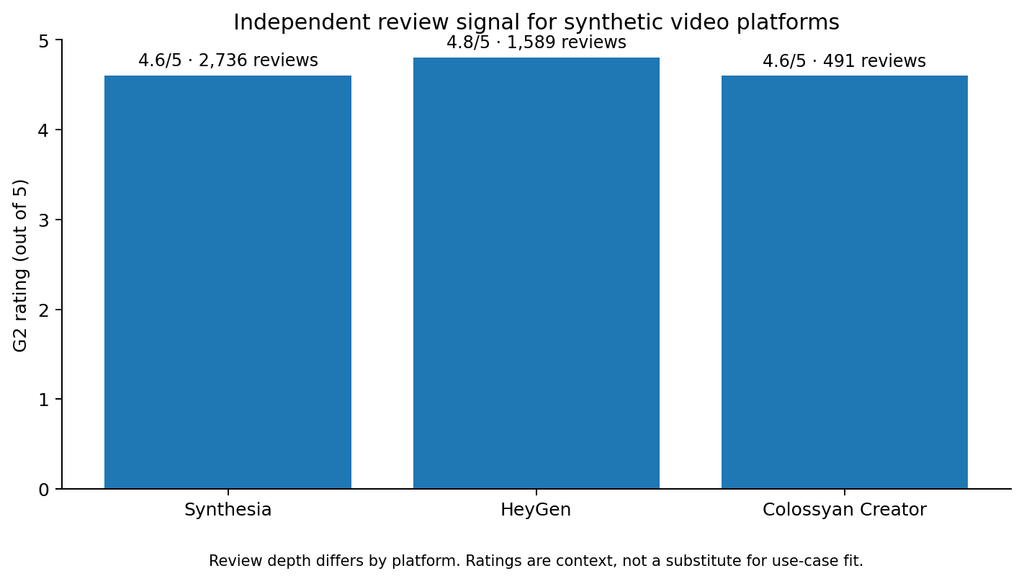
| Synthesia | Training, onboarding, internal communication, multilingual business video | Basic $0, up to 10 video minutes/month; Starter $29/month | 4.6/5 · 2,736 reviews | Ease, scalable training, localization, professional avatars | Emotional range, rerender time and minute caps can constrain some workflows |
| HeyGen | Marketing, founder digital twins, social explainers, localization | Free 3 videos/month; Creator $29/month | 4.8/5 · 1,589 reviews | Realistic avatars, lip sync, ease and production speed | Pricing, credit use and avatar limitations appear repeatedly in reviews |
| Colossyan Creator | Learning and development, interactive training, course creation | Free tier; Professional $59/month annual | 4.6/5 · 491 reviews | Ease, training workflow, multilingual support, LMS fit | Lip sync, emotion and avatar limits remain recurring concerns |
Figure 3. Current G2 review signal for three synthetic AI video platforms. Review volume and rating help show maturity, but use-case fit should drive the decision.

Synthesia: best when video is replacing documents and repeat training
Synthesia is positioned heavily around business communication, training, onboarding and multilingual video. Its current pricing page lists a Basic plan at $0 with up to 10 minutes of video per month, Starter at $29 per month and Creator at $89 per month, with higher avatar, usage and collaboration access as plans increase.
Its G2 profile currently shows 4.6/5 from 2,736 reviews. Repeated positives include ease of use, avatar quality, localization and time savings. Recurring negatives include minute limits, cost, rerender time and the fact that avatars can still feel less expressive for high-emotion storytelling.
Social Scion assessment: Synthesia is strongest when consistency is the goal. Policies, training, onboarding, product education and repeat internal communication benefit from a predictable synthetic presenter. It is less compelling when the business needs a highly emotional customer story where subtle performance is the point.
HeyGen: best when a digital twin needs to feel closer to a real creator
HeyGen has pushed heavily into digital twins, photo avatars, video agents, voice cloning and multilingual production. Its current pricing page includes a free plan with three videos per month, Creator at $29 per month and Pro at $49 per month, with higher credit pools and production features on paid plans.
HeyGen’s June 2026 documentation describes its Digital Twin on Avatar IV as a personal AI avatar built from real footage that can preserve body language, expressions, rhythm and delivery style. Its G2 profile currently shows 4.8/5 from 1,589 reviews. Ease, realism, lip sync and production speed lead the positive themes, while cost, credit consumption and avatar limits appear among the recurring negatives.
Social Scion assessment: HeyGen fits a business owner, expert or presenter who has a clear voice and wants that presence to travel without recording every version. The risk is letting the convenience of a digital twin create more talking-head output than the audience needs.
Colossyan Creator: best when synthetic video is part of learning design
Colossyan is more explicitly designed around training and enablement. Its current pricing page offers a free tier for individuals, while Professional is $59 per month on an annual plan and adds more generation minutes, SCORM export, AI image generation and team features.
The Colossyan Creator G2 profile currently shows 4.6/5 from 491 reviews. Review summaries repeatedly praise ease of use, realistic avatars, multilingual support and training workflows. Lip sync, avatar limitations, emotional range and price appear among the tradeoffs.
Social Scion assessment: Colossyan makes more sense when the video belongs inside a learning system rather than a marketing feed. If quizzes, branching, SCORM, localization and structured training matter, its production logic is closer to the job than a general social video generator.
How to Produce Synthetic AI Video Without Losing the Human Source
1. Define the real communication job
Write the result the video needs to create: explain a service, onboard a client, teach a process, localize a founder message, visualize a concept, answer a recurring question or build awareness. “We need more video” is not a production brief.
2. Separate source truth from synthetic execution
Create a source sheet with approved facts, claims, names, pronunciations, prices, outcomes, quotes and visual references. Mark what AI may transform and what it may not invent.
3. Choose the synthetic format based on the job
Use a digital twin when the real person’s presence matters. Use a stock presenter when the message matters more than identity. Use generated scenes when visualization matters. Use AI-assisted editing when real footage already contains the story.
4. Lock identity permissions before generation
For digital twins, voice clones, customer likenesses or employee avatars, document approval before production starts. Keep the consent attached to the source asset, not buried in an email chain.
5. Generate the shortest useful version first
Do not begin with a five-minute synthetic video. Test 20 to 45 seconds and watch for eye movement, gestures, product accuracy, lip sync, pronunciation, pacing and moments where the synthetic performance becomes distracting.
6. Run the reality test
Ask a reviewer who did not build the video what they think is real. If they believe a generated scene actually happened or that a synthetic presenter is a real customer or employee, add the context or disclosure needed before publishing.
7. Check the channel’s disclosure rules
YouTube, Vimeo and other platforms can have different requirements. Check the current rule for the exact channel and content type before upload rather than relying on old guidance.
8. Connect the video to an owned source
A synthetic explainer should lead to the real service page. A synthetic product story should lead to the real product. A translated founder video should connect to the approved written source. Let the synthetic asset open the door, then let owned evidence carry the trust.
9. Measure the communication outcome
Track whether the video reduced support questions, improved onboarding completion, generated qualified clicks, increased product understanding, shortened sales explanation time or moved another real business action. Synthetic production is useful when it removes cost or friction without reducing trust.
For YouTube-specific workflows, Social Scion’s Making Video with AI guide is a useful companion because it connects AI production to channel intent, search behavior and viewer action rather than treating generation as the end of the workflow.
Practical Exercise: The Synthetic or Real Decision
Before choosing a tool, take one planned video and classify every part of it.
What must be real because it is evidence?
What can be synthetic because it is only delivery or visualization?
Whose face, voice or identity appears, and is that use approved?
Could any generated scene be interpreted as direct footage of a real event?
What platform disclosure will be required?
What human review is needed before the asset goes live?
Where does the viewer go to verify the product, service, result or claim?
Practical AI prompt: preserve truth while planning synthetic video
| Use verified information only Plan a synthetic AI video from the verified business information below. Separate the brief into two columns: SOURCE TRUTH and SYNTHETIC EXECUTION. SOURCE TRUTH must contain only verified facts, approved quotes, real product capabilities, real outcomes, approved identity details and claims that cannot be changed. SYNTHETIC EXECUTION may suggest avatar, digital twin, generated scene, voice, B-roll, translation, pacing and editing choices. Do not invent customer quotes, metrics, events, product behavior, founder history or consent. If required evidence is missing, mark it [NEEDS SOURCE]. Then produce a 30 to 45 second video structure and a disclosure checklist for publication. Verified information: [paste source]. |
|---|
When Should a Small Business Pay for Synthetic Video Software?
A paid plan makes sense when the synthetic workflow has already proven it removes a repeated production cost.
You repeatedly record the same founder, trainer or spokesperson message with small updates.
You need reliable multilingual versions and re-recording every language is impractical.
Training, onboarding or support content changes often enough that traditional reshoots become a bottleneck.
You need brand controls, watermark removal, higher export quality, custom avatars, collaboration or API access.
You can quantify the production time or outsourced cost the synthetic workflow replaces.
The video format has a clear business outcome beyond simply increasing output volume.
Stay manual when the most important value of the video is the irreplaceable human performance itself. A customer sharing an emotional recovery story, a founder responding to a sensitive event, or an employee speaking about a difficult lived experience may lose more in trust than the business gains in production efficiency if that performance is synthesized.
Common Synthetic AI Video Mistakes
Choosing the most realistic avatar instead of the right format
Realism is useful only when human presence helps the message. Some stories are stronger as product animation, real photography, voiceover, screen recording or a simple visual explainer.
Treating consent as a one-time technical checkbox
A person may approve creation of a digital twin without approving every future script, ad, channel or commercial use. Define the scope of permission clearly.
Using synthetic customer proof
Do not create a synthetic customer to deliver a real review unless the presentation is clearly framed and authorized. The more the execution looks like first-person evidence, the more easily viewers can misunderstand its source.
Letting the model invent product details
Generated B-roll can subtly change packaging, interfaces, rooms, ingredients, equipment or product behavior. Review every visible business detail, not only the script.
Assuming disclosure hurts performance
YouTube explicitly says disclosure does not by itself reduce audience or monetization eligibility. Hiding required context creates a larger trust and platform risk than labeling it.
Publishing a perfect avatar with a generic script
Synthetic production magnifies writing quality. A polished digital twin repeating broad corporate language can feel less human than a simple real voice recording with one specific idea.
Confusing provenance with truth
Content Credentials can document how media was created or edited. They do not prove that the underlying business claim is accurate. Provenance and evidence solve different trust problems.
Scaling before the first workflow is useful
Do not build 50 synthetic videos because the plan includes the minutes. First prove that one format helps customers understand, trust or act more easily.
FAQ: Synthetic AI Video in 2026
What is synthetic AI video?
Synthetic AI video is video in which AI creates, replaces or materially transforms visual or audio elements that would traditionally have been recorded from a real person, place, object, voice or event. It includes AI avatars, digital twins, generated scenes, voice cloning and some AI-assisted edits.
Is synthetic video the same as a deepfake?
No. Deepfake usually describes deceptive or unauthorized synthetic media involving a real person or event. Synthetic video is a broader production category and can be transparent, consensual and accurate.
Do I have to label AI-generated video on YouTube?
YouTube requires disclosure when realistic AI meaningfully alters or generates content that could mislead viewers about a real person, place, event or realistic scene. Minor edits and clearly unrealistic content are treated differently.
Does an AI label hurt YouTube monetization?
YouTube says disclosing realistic altered or generated content does not by itself limit the audience or affect monetization eligibility.
What is a digital twin video?
A digital twin video uses an AI representation of a real person, often trained from approved footage, photographs or voice samples, so new scripts can be delivered without recording every version physically.
Which synthetic video tool is best for small business?
HeyGen is a strong fit for marketing and creator-style digital twins, Synthesia is strong for structured business communication and training, and Colossyan is strong for learning and enablement workflows. The best tool depends on the job.
Can AI clone my voice and face for business videos?
Yes, several platforms support digital twins and voice cloning. Use only approved identity assets and define the scope of consent before publishing.
What is C2PA?
C2PA is a technical standard for recording provenance information about digital media through Content Credentials. It helps document media origin and edit history, but it does not independently prove that a claim in the content is true.
Should customer testimonials use synthetic presenters?
Use caution. A testimonial is evidence from a customer, so the presentation should not make viewers believe a synthetic actor is the actual customer unless that is clearly explained and authorized. Real customer language can be adapted into other formats without manufacturing a false witness.
The 2026 Stance: Synthetic Production Is Normal. Synthetic Truth Is Not.
Synthetic AI video is becoming another layer in the production stack, the way digital editing, green screen, CGI, stock footage and voice processing became normal layers before it.
The mistake is treating that normalization as permission to syntheticize everything.
The parts worth automating are the repeatable production burdens: rerecording, translation, presentation, background creation, format adaptation, product visualization and editing. The parts worth protecting are the things the audience is actually trusting: what happened, what the product does, what the customer experienced, what the founder believes, what an employee said, and whether the person on screen agreed to be there.
As synthetic media becomes harder to recognize by sight, good production will include more than clean motion and lip sync. It will include source discipline, identity permission, disclosure, human review and an owned place where the real story can be checked.
That is not a limitation on creativity. It is what lets synthetic production scale without making the business feel synthetic too.
Your Story Should Stay Real Even When the Production Is Synthetic
A business does not need to choose between human storytelling and AI production. The strongest workflow keeps the source human and lets AI remove the production weight around it.
Social Scion AI starts with the founder insight, customer proof, product truth and audience need before choosing cinematic scenes, avatars, product motion, UGC-style proof or another AI-native format. The production can change. The truth does not.
| Get your Free Film See what happens when the real business story becomes the source before the synthetic production layer begins. Claim the Free Film Your story works while you work. |
|---|