


Key Takeaways
|
|---|
Figure 1. AI video content marketing should move one story through Attract, Engage and Convert rather than multiply content without a journey.
AI Is Making More Video. The Marketing Problem Is Becoming What Deserves Distribution.
On September 10, IAB published an update that makes the current content marketing tension unusually clear.
Its September 2026 Outlook update found that optimizing content for AI-generated answers had become the top area of increased focus among buyers at 76%. Focus on AI language models reached 72%, and generative AI use in media campaigns stood at 69%.
At the same time, 44% of buyers named changing consumer behavior around AI-driven search as their top media investment challenge. Another 38% cited concern about low-quality AI-generated content.
That is the paradox.
Marketers need more content that can travel through AI discovery, social video, search, paid media and owned channels. They also know that low-quality AI output is becoming part of the problem.
Instagram offered a parallel warning the same day. The Guardian reported comments from Instagram head Adam Mosseri arguing that a purely chronological feed could overwhelm people with the volume of brand content they follow. Whatever position someone takes on feed algorithms, the marketing lesson is straightforward: brands already produce enough content to become noise.
AI makes that easier to do.
The strategic advantage is therefore not more video. It is a better system for deciding which story deserves to become video, how that video should change across the customer journey, and where the relationship should go after the view.
This is why AI video content marketing should be treated as a content system rather than a production shortcut.
Figure 2. IAB’s September 2026 update shows marketers focusing simultaneously on AI discovery, GenAI execution and new measurement models.
What Is AI Video Content Marketing?
AI video content marketing is the use of artificial intelligence to help research, plan, produce, edit, adapt, distribute and measure video content that moves an audience through a business journey.
The important word is content.
An AI-generated clip is not automatically content marketing. It becomes content marketing when it answers a customer question, demonstrates a product, builds familiarity, corrects a misconception, proves a claim or creates a next step in the relationship.
AI video content marketing vs. AI video advertising
Advertising buys distribution around a message. Content marketing earns and compounds attention over time through useful or memorable assets. The same video can support both, but the operating logic differs.
An ad may be optimized for one campaign event. A content asset can keep working across search, the website, email, sales conversations and organic discovery.
AI video content marketing vs. social media content
Social media is one distribution environment. Content marketing is the larger system.
A Reel can attract attention. The article or landing page can explain the idea. Email can continue the relationship. A sales film can answer the objection. A case study can prove the result.
The system becomes stronger when those assets come from the same source instead of behaving like five unrelated campaigns.
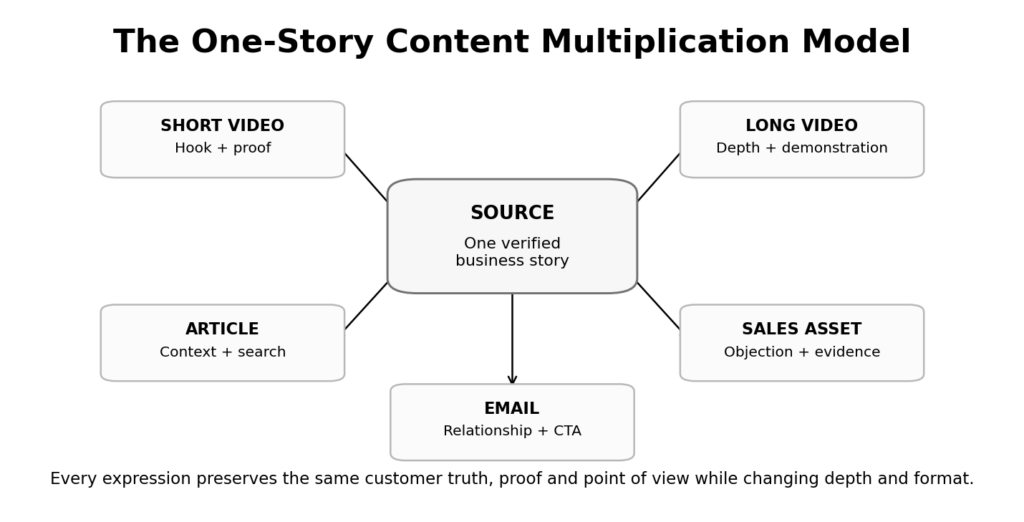
The One-Story Content Multiplication Model
AI becomes most valuable after the source story has earned the right to be multiplied.
Figure 3. One verified source story can become short video, long video, an article, email and sales material without becoming five different messages.
The model starts with one verified source:
- a customer interview
- a founder point of view
- a product demonstration
- a repeated sales objection
- a review pattern
- a useful market development
- a real process the customer rarely sees
AI can then help compress or expand the same source without changing what is true.
The long video gives the idea room. The short clip earns attention. The article supplies context and search value. Email creates another touchpoint. The sales asset brings the story closer to the buying decision.
The source becomes more valuable because each expression points back to the same meaning.
7 Rules for AI Video Content Marketing That Compounds
1. Start With a Story Job, Not a Video Format
Before choosing Reel, avatar, product film or cinematic short, decide what the customer needs from the story. Attract means earn the stop. Engage means explain or prove. Convert means create a useful next step. Format follows job.
2. Build From a Verified Source
Feed AI source material the business can stand behind: customer language, founder notes, product documentation, reviews, interviews, demos or current research. The better the source, the less generic the output becomes.
3. Make One Asset the Canonical Story
Choose one complete version where the meaning and proof live together. It may be a long video, article, customer case or product page. Shorter content should point back to this source rather than becoming the only place the story exists.
4. Adapt Depth, Not Truth
A 20-second clip can carry the tension. A two-minute video can add the example. An article can add sources and steps. An email can bring the same idea into the reader’s inbox. Each version changes depth, not the underlying claim.
5. Give AI the Repetitive Work
Use AI for transcripts, rough cuts, captions, alternate hooks, translations, format changes, summaries and first-pass repurposing. Keep positioning, proof, customer interpretation and final approval under human control.
6. Design the Owned Handoff
Every rented channel should have somewhere useful to send the audience. That may be the website, newsletter, product page, Free Film form or booked call. A video can perform well socially and still create little business value if the relationship ends with the view.
7. Measure the Story Across the Journey
Do not judge every video by the same KPI. Attract assets can be evaluated by qualified attention and retention. Engage assets can be evaluated by deeper viewing, clicks or return visits. Convert assets should be evaluated by lead capture, product action or booking.
|
The compounding rule Do not ask AI to create more disconnected videos. Give it one approved source story, then adapt that story into formats that serve different stages of the customer journey. |
What September 2026 Is Signaling About Video Content Strategy
YouTube is becoming a combined paid, owned and creator environment
On September 9, Pixability described growing demand for AI-powered solutions that connect paid advertising, organic content and creator marketing on YouTube. The statement is a vendor announcement, so it should not be treated as independent proof of performance. It is still a useful market signal because the categories are no longer being planned as separate islands.
For a small business, the practical version is simpler: one useful YouTube or website video can create organic discovery, retargeting material, social clips and sales support if the source is planned for reuse.
Creator integration is becoming part of the story, not only media placement
Google’s September 2 partnership with MrBeast gives another clue. Google described Gemini as part of the creator’s problem-solving process inside a large-scale YouTube challenge rather than simply as a pre-roll advertisement.
Most small businesses will never produce at MrBeast scale. The content principle still travels: the product or service is stronger when it participates in the story rather than interrupting it.
AI can improve the brief before it multiplies the video
Billo’s September 9 product announcement makes the production order explicit. Its new script generator starts from the product link and uses campaign data to create briefs before matching creators. Billo says the system is trained on its internal ad history, including hundreds of thousands of active ads and substantial ad spend.
Those figures come from the vendor and should be treated as company claims. The useful principle is broader: performance starts with the brief, not the render.
3 Tools for a Practical AI Video Content Marketing Workflow
A content system needs three different capabilities: capture the human source, shape and repurpose the source, then host and measure the asset where the business can learn from it.
|
Tool |
Best content-marketing job |
Current pricing |
G2 signal |
Strength |
Tradeoff |
|
Riverside |
Capture interviews, founder conversations, podcasts and source video |
Free; Standard $19 monthly or $15 annual; Pro $29 monthly or $24 annual |
4.8/5 · 1,749 reviews |
High-quality remote capture, transcripts, editing and clips from one source |
Best value appears when interviews or recordings repeat |
|
Descript |
Edit and repurpose spoken video |
Free; Hobbyist $16 annual or $24 monthly; Creator $24 annual or $35 monthly |
4.6/5 · 921 reviews |
Transcript-led editing, clips, captions, AI cleanup and reusable spoken-media workflow |
Media-hour and AI-credit limits matter for heavier production |
|
Wistia |
Host, measure and connect video to marketing outcomes |
Free; Business $79/month; Business + Lead gen $329/month |
4.6/5 · 1,165 seller reviews |
Business video hosting, analytics, CTAs, forms and marketing integrations |
Lead-gen tier is expensive for very small teams until video volume and pipeline justify it |
Figure 4. G2 review depth for three tools that support capture, repurposing and owned video marketing.
Riverside: best when the customer or founder voice is the source
Riverside is useful when the content system begins with real people.
Its current pricing offers free access, Standard at $19 per month or $15 with annual billing, and Pro at $29 monthly or $24 annually. Paid tiers increase multi-track recording time and production features.
The Riverside G2 seller profile currently shows 4.8/5 across 1,749 reviews. Reviewers repeatedly praise recording quality, ease of use and the ability to move from recording into editing and clips.
Social Scion assessment: use Riverside when one strong conversation can become several content assets.
Descript: best when the source already exists as spoken video
Descript fits the middle of the system. It is especially strong when the story already exists in an interview, webinar, screen recording or founder video.
The current Descript pricing lists Hobbyist at $16 per person per month with annual billing and Creator at $24 per person per month annually. Paid plans add more media hours, AI credits, 1080p or 4K export and broader Underlord features.
The Descript G2 seller profile currently shows 4.6/5 across 921 reviews. Ease, transcript-based editing and time savings dominate recent reviews.
Social Scion assessment: use Descript to preserve exact human language while making one recording easier to turn into clips, captions and text-based assets.
Wistia: best when video should become an owned marketing asset
Wistia becomes useful at the point where the business wants more than views.
Its current pricing page offers a free plan with 25 GB storage and basic analytics. Business costs $79 per month and adds deeper analytics, brand controls, CTAs and forms. Business + Lead gen costs $329 per month and connects video engagement to marketing automation and lead scoring.
The Wistia G2 seller profile currently shows 4.6/5 across 1,165 reviews. Reviewers frequently highlight video hosting, analytics and ease of embedding into websites and help content.
Social Scion assessment: Wistia is most useful when the video library itself becomes part of lead generation or customer education. A small business that only needs simple embeds may not need the higher-priced lead-generation tier.
The Myth: AI Video Content Marketing Means Publishing Every Day
Daily publishing can be useful. It is not the definition of a content system.
The volume mindset assumes every day needs a new idea.
A compounding system asks a different question: how many useful customer moments can one strong source support?
A founder interview may contain a market insight, one customer objection, one product explanation, three useful short clips and the opening for a newsletter. A customer case may become a film, article, sales slide, email and search answer.
The difference is not laziness.
It is asset economics.
The source gets more valuable because the business keeps extracting useful expressions from something real rather than manufacturing a new generic idea every morning.
How to Build an AI Video Content Marketing System in 9 Steps
1. Choose one customer question
Start with the issue a qualified buyer already asks, not with the format you want to produce.
2. Find a source the business can own
Use a founder interview, customer quote, product demo, process, review pattern or current development connected to your expertise.
3. Write one canonical story
Create the complete version with context, proof and point of view before shortening it.
4. Assign the story a journey job
Decide whether the primary role is Attract, Engage or Convert.
5. Create the main video
Use the format that carries the story best: founder-led, product-led, customer-led, cinematic, UGC-style or another appropriate form.
6. Let AI create controlled adaptations
Generate clips, alternate hooks, transcripts, captions, email versions, article summaries or localized versions from the approved source.
7. Send every rented asset toward an owned destination
Use the website, product page, email list, lead magnet or booking flow as the place where attention becomes a relationship.
8. Measure the correct stage
Do not demand bookings from an awareness clip or judge a sales video only by reach. Match the KPI to the job.
9. Feed the learning back into the source library
Save customer phrases, retention moments, objections, search terms and conversion patterns. The next story should begin with what the previous one taught you.
Practical Prompt: Turn One Verified Story Into a Video Content System
|
Keep the story fixed. Change the depth and format. Build a video content marketing system from the verified source below. First identify: Then create: For every asset explain: Do not invent customer quotes, results, product facts, prices, founder history or evidence. If information is missing, mark it [NEEDS SOURCE]. Verified source: [paste source]. |
When Should a Small Business Pay for a Video Content Marketing Stack?
Pay when the workflow repeats enough that a tool removes work from an existing system.
- Remote interviews or founder recordings happen often enough that reliable capture and transcription save time.
- One recording regularly needs several clips, captions and written derivatives.
- Video is becoming a meaningful owned website or lead-generation asset rather than only a social post.
- Localization or multiple channel formats create enough repeated production to justify AI-assisted adaptation.
- The paid plan helps connect engagement data to leads, pipeline or another business outcome the team already measures.
Do not buy a larger stack because the team wants to publish more. Buy it when the business already knows which source stories deserve repetition.
Common AI Video Content Marketing Mistakes
Treating every video as a new campaign
The audience sees a different brand every time when the underlying customer truth keeps changing.
Publishing before deciding the journey job
An awareness clip, educational video and conversion asset should not all carry the same amount of context or the same CTA.
Letting AI invent the source story
A generated customer tension is usually broader and less credible than the language already inside sales calls, reviews and interviews.
Optimizing only for social reach
A large view count can remain rented attention if the audience has nowhere useful to go next.
Repurposing by copy and paste
The same video caption dropped into email and the website is not adaptation. Depth, framing and action should change by medium.
Building a stack with overlapping tools
One capture tool, one editing workflow and one owned hosting or measurement layer is usually clearer than several products doing the same job.
Measuring every asset by conversion
Top-of-funnel content creates discovery and familiarity. Demand creation and demand capture need different success measures.
Ignoring AI discovery
If customers increasingly discover brands through AI answers, the complete written and video source should be clear enough to be understood, cited and connected to the business entity.
FAQ: AI Video Content Marketing in 2026
What is AI video content marketing?
AI video content marketing uses artificial intelligence to help plan, produce, edit, adapt, distribute and measure video content that supports a customer journey rather than existing as isolated content.
How is AI video content marketing different from AI video ads?
Ads buy distribution around a message. Content marketing builds an owned library and relationship over time. The same video can support both, but the role and measurement differ.
What should AI automate in video content marketing?
AI is useful for transcripts, rough cuts, captions, alternate hooks, translations, summaries, format changes and controlled repurposing after the source is approved.
What should stay human?
The customer truth, product facts, proof, point of view, offer, story selection and final approval should remain human-controlled.
How many videos should a small business publish?
There is no universal number. Publish enough to serve the customer journey consistently without lowering source quality or creating a content volume the business cannot learn from.
Can one video become several content assets?
Yes. A strong source can become long video, short clips, an article, email, sales material and FAQ content if each version preserves the same truth while changing depth and format.
What tools are useful for AI video content marketing?
Riverside is useful for capturing source conversations, Descript for editing and repurposing spoken video, and Wistia for owned hosting, analytics and lead-generation workflows.
How should video content marketing be measured?
Use journey-specific metrics. Attention and retention fit Attract. Clicks and deeper engagement fit Engage. Leads, product action and bookings fit Convert.
Does AI content hurt trust?
AI use alone does not determine trust. Generic or unsupported content can weaken credibility. Verified proof, recognizable language and clear human responsibility make AI-assisted content stronger.
How does AI search change video content marketing?
Brands increasingly need content that is clear enough for AI systems to understand and cite. Video should be supported by transcripts, direct answers, structured written context and consistent entity information on owned pages.
The 2026 Stance: AI Should Multiply the Story, Not Multiply the Noise
AI is reducing the cost of producing video at the same time that brands are competing across more surfaces.
That creates an obvious temptation: fill every surface.
The better strategy is to make the source stronger.
One customer truth can become a film, short video, article, email, sales asset and search answer. Each piece has a different job, but the audience keeps encountering the same recognizable business.
That is where content begins to compound.
Not because the business published more.
Because every useful asset made the next one more valuable.
Start With the Story Before You Build the Content Engine
Your business already contains source material that can travel further: customer language, product truth, founder expertise, real proof and questions buyers keep asking.
Social Scion AI starts there, then builds the video and content system around what should attract, engage and convert.
|
Get your Free Film See what happens when one real story becomes the source for a video content system instead of another isolated post. Claim the Free Film Story that attracts. System that converts. |