


Key Takeaways
|
|---|
Figure 1. Six controls to keep before handing more of a video ad campaign to platform automation.
Video AI Ads Are Becoming a Control Problem, Not a Generation Problem
The newest advertising systems can do more than create a video.
They can decide where the video runs, which audience sees it, how budget moves, which creative combination gets served and which version deserves more delivery.
That changes the advertiser’s job.
TikTok’s September 2026 Smart+ updates make that shift explicit for small and midsize advertisers. TikTok now lets SMBs choose full automation, partial automation or manual control across audience, budget, placements and catalog settings.
The broader Smart+ framework is designed around modular automation. Advertisers can let the platform optimize targeting, budget and placements, or retain manual control over selected modules. The campaign can support large numbers of asset combinations while the system learns what works.
Meta’s September 17 update makes the delivery side more visible to users. Its Why am I seeing this ad? transparency experience is now live on Facebook Reels, extending explanations of how machine-learning systems and activity signals can shape ad delivery.
Google is pushing in the same direction from the measurement side. Rethink 2026 emphasizes AI-powered performance, data foundations and faster decision-making, while Google’s September measurement update frames better first-party data and causal measurement as essential inputs for AI-driven campaigns.
The result is a new operating reality.
AI can make more video ads. Platforms can distribute them more dynamically. The business still has to decide what must not drift.
That is the control layer.
Figure 2. September 2026 signals show more automation in video advertising, alongside stronger expectations for transparency, data quality and advertiser control.
What Are Video AI Ads?
Video AI ads are video advertisements created, adapted, assembled, targeted or optimized with artificial intelligence.
The AI contribution may happen in one layer or several:
- storyboarding and concept generation
- text-to-video or image-to-video production
- automated editing and reframing
- voice, captions or localization
- creative combinations
- audience expansion
- placement selection
- budget optimization
- campaign measurement and prediction
This is why the phrase should not be treated as another synonym for AI-generated video.
The most important AI in the campaign may be the system deciding which creative version, audience and placement receives the next dollar.
Video AI ads vs. AI-generated video ads
AI-generated video ads focus on how the asset is made. Video AI ads can include the full media system around that asset, including targeting, delivery, combinations, budget and optimization.
Video AI ads vs. automated campaigns
An automated campaign can optimize media without generating the core creative. A video AI ad workflow connects both sides: human or AI-made creative feeds an AI-driven campaign system.
Video AI ads vs. creative testing
Creative testing asks which version performs better and why. Platform automation may choose winners automatically. The business still needs a test structure clear enough to turn performance into learning.
What Humans Should Own and What Platforms Can Automate
Automation works best when the platform has permission to optimize inside a clearly defined business strategy.
It works poorly when the strategy itself is left undefined.
Figure 3. A practical split between advertiser-owned decisions and platform automation.
The split is not permanent.
Some businesses will keep tighter manual control because of regulation, brand risk, small budgets or limited conversion data. Others can automate more because the offer is proven and the platform has strong signals.
The principle is stable: automate the repeated decisions after the business has defined the non-negotiables.
6 Controls to Keep Before Platforms Automate the Rest
1. Keep Control of the Offer
AI can rewrite headlines and assemble variations. It should not quietly change what the customer is being promised. Lock the product, price, offer structure, eligibility, exclusions and desired action before creative automation begins.
2. Keep Control of the Proof
The platform can optimize which proof appears. The proof itself still needs to be real. Customer outcomes, product capabilities, before-and-after results, comparisons, reviews and guarantees should be verified before they enter the asset library.
3. Keep Control of the Creative Idea
Do not confuse fifty variations with fifty ideas. Define the customer tension, point of view and creative hypothesis first. Then let AI explore hooks, formats and executions around that idea.
4. Build an Asset System, Not a Folder of Random Ads
Give the platform enough useful variation to learn. Create distinct hooks, proof moments, formats and CTAs while keeping the core offer stable. This creates breadth without losing the ability to interpret results.
5. Keep Guardrails Around Audience, Placements and Budget
Automation should reflect business boundaries. Location, age, exclusions, sensitive-category restrictions, brand safety, daily spend and placement limits should be intentional decisions rather than forgotten defaults.
6. Keep Measurement Close to the Business Outcome
AI optimizes toward the signals it receives. If the conversion event is weak, delayed or noisy, the platform can become very efficient at the wrong behavior. Feed the system events that represent real progress, then use causal or controlled tests when the decision is important.
|
The control rule Let the platform automate delivery and variation only after the business has defined the message, proof and boundaries. |
The Video AI Ads Asset System
AI-powered media systems need enough creative variety to avoid fatigue and find stronger combinations.
The mistake is feeding them variety with no structure.
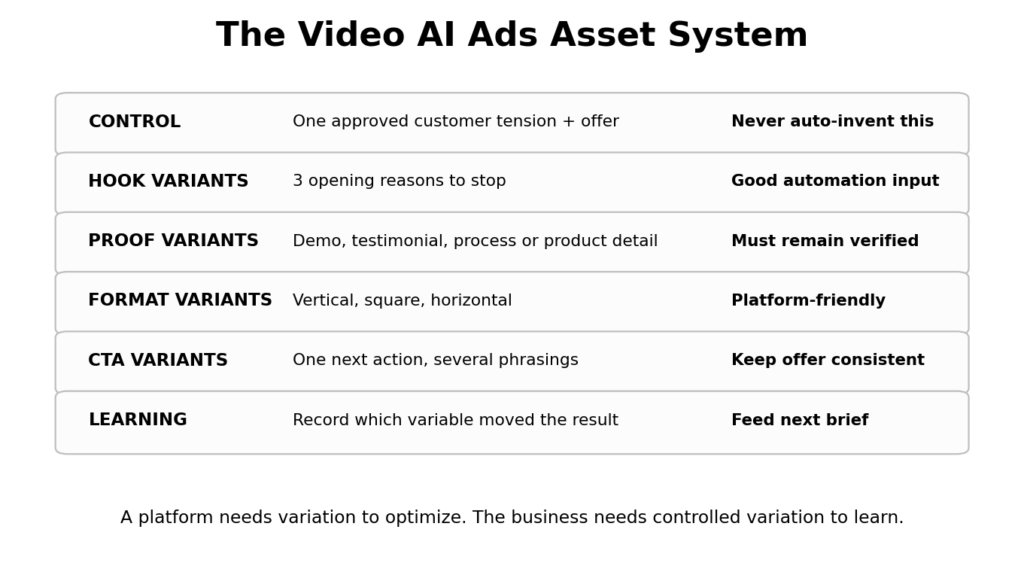
Figure 4. A controlled asset system gives the platform variation while preserving advertiser learning.
A useful starting library for one offer might include:
- three opening hooks based on different customer tensions
- two proof treatments, such as product demonstration and customer evidence
- one founder or presenter version
- one product-only version
- vertical, square and horizontal crops or native compositions
- two CTA phrasings that lead to the same action
That is enough creative diversity for a platform to learn without turning the campaign into a pile of unrelated messages.
3 Platform Workflows That Show Where Video AI Ads Are Going
|
Platform |
AI role |
What advertiser controls |
Useful current feature |
Main risk |
|
TikTok Smart+ |
Automates or assists audience, budget, placements, catalog and creative delivery |
Modules can be automated or manual, with advertiser-defined basics and campaign structure |
September SMB updates emphasize full, partial or manual automation |
Too much variation without a clear creative system can produce performance without reusable learning |
|
Google Demand Gen |
Combines AI-generated or uploaded assets with automated multi-surface delivery |
Assets, audience signals, channel controls, conversion goals and campaign setup |
Multimodal Video Creation and multi-format delivery across YouTube and Google surfaces |
Weak conversion signals or generic source assets can teach the system to optimize the wrong thing |
|
Meta Reels / Ads |
Uses machine learning for relevance and delivery across Meta surfaces |
Creative, objective, account data, audience constraints and brand controls |
Expanded Why am I seeing this ad? transparency now live on Facebook Reels |
Advertisers still need to understand how automated delivery interacts with creative and user expectations |
TikTok Smart+: best example of modular automation
TikTok’s Smart+ design is useful because automation is not treated as one irreversible switch.
The current Smart+ documentation lets advertisers automate or manually configure targeting, budget, placement and catalog modules. TikTok also supports large asset structures and creative combinations.
Social Scion assessment: keep the creative brief and proof system human-led, then automate media modules where the account has enough data and the business understands the guardrails.
Google Demand Gen: strongest when creative and distribution need to work as one system
Google has steadily moved video, image and automated creative into one Demand Gen environment.
Its August Demand Gen update made Multimodal Video Creation generally available, allowing advertisers to move from storyboarding into horizontal and vertical video assets in the same workflow.
Google also reports that advertisers using both video and image assets in Demand Gen saw 20% more conversions at the same cost per action than video-only advertisers. That is Google internal data and should be treated as directional platform evidence, not a universal benchmark.
Social Scion assessment: use Demand Gen when the business can feed several approved creative forms into one campaign and measure a meaningful conversion event.
Meta Reels: transparency matters more as automated delivery becomes normal
Meta’s September 17 update does not change how an advertiser creates the video. It changes the surrounding expectation.
Users can now access more explanation about why a Facebook Reels ad was shown to them.
Social Scion assessment: as platforms make machine-learning delivery more visible, advertisers should be equally clear internally about what data, creative and targeting choices are driving the campaign.
AI Ads Need Better Measurement, Not More Dashboards
Google’s September measurement update describes three requirements for AI-era performance: a strong data foundation, multiple signals and causal proof.
That is a useful framework for video AI ads because platform automation becomes more aggressive as the available signals improve.
For a small business, this does not require a giant analytics stack.
It means:
- the website conversion is tracked reliably
- lead quality can be separated from raw lead volume
- sales or booking outcomes can be connected back to campaigns where possible
- creative tests change one important variable at a time
- brand or upper-funnel assets are not judged only by last-click conversion
The platform should know what event to optimize.
The business should know whether that event is actually valuable.
The Bigger Risk: AI Can Scale Weak Creative Faster
The IAB’s September 2026 Outlook Study shows advertisers increasing focus on AI-driven discovery and AI-based marketing systems while also naming low-quality AI-generated content as a concern.
That tension is exactly where video AI ads sit.
Automation lowers the cost of testing and distribution.
It also lowers the cost of repeating a weak idea.
A bad manual campaign may waste a few assets.
A bad automated campaign can generate, combine and distribute weak creative at much greater speed.
The answer is not to turn AI off.
It is to make the creative source stronger before the campaign scales.
Example: A Local Service Business Builds a Video AI Ad System
Imagine a local home-renovation business wants to generate more kitchen-remodel consultations.
The weak workflow gives a platform ten generic renovation videos and asks it to optimize.
The stronger workflow starts with one verified customer tension: homeowners are afraid the project will run weeks past schedule.
The business builds:
- Hook A: ‘The part of a kitchen renovation that usually breaks the timeline.’
- Hook B: a visual before-and-after of the project calendar rather than the room.
- Hook C: the project manager explaining the three checkpoints that prevent delays.
- Proof A: a real project timeline with identifying details removed.
- Proof B: a customer quote about schedule communication, used with permission.
- Formats: vertical Reels/TikTok, square feed and horizontal YouTube.
- CTA: one consultation offer across every version.
The platform can now optimize formats, placements and combinations.
The business still knows what the campaign is learning because the customer tension and offer stayed fixed.
How to Build a Video AI Ads Workflow in 9 Steps
1. Lock the offer
Write the product, price or next action exactly as the customer will encounter it.
2. Choose one customer tension
Use sales calls, reviews or product behavior rather than a generic AI-generated pain point.
3. Attach proof
Select the demonstration, review, result, process or product detail that makes the message believable.
4. Write one creative hypothesis
State what you believe will make this audience act and why.
5. Build controlled asset variation
Create different hooks, proof treatments and formats while keeping the core offer stable.
6. Set platform guardrails
Choose what can be automated and what must stay manual across audience, budget and placements.
7. Feed the right conversion signal
Optimize toward a meaningful event, not the easiest event to collect.
8. Review combinations, not only individual ads
Automated systems may create strong performance from a specific asset combination. Capture which pieces worked together.
9. Turn performance into the next brief
Record the winning customer tension, proof, format and offer so the next campaign starts smarter.
Practical Prompt: Build Controlled Video AI Ad Variants
|
Give the platform variation without giving away the strategy Build a controlled AI video ad asset system from the verified campaign source below. LOCK: CREATE: For every asset identify: Do not invent testimonials, results, prices, product capabilities, founder history or scarcity. If a required fact is missing, mark it [NEEDS SOURCE]. Verified campaign source: [paste source]. |
Common Video AI Ads Mistakes
Automating before the offer is stable
A platform can optimize delivery faster than the business can diagnose a weak offer.
Feeding the system random creative variety
Variation should help the campaign learn. Unrelated ads create noise.
Treating auto-generated video as strategy
Platform-generated formats solve production gaps, not customer insight.
Optimizing toward a weak conversion event
Cheap clicks or low-quality leads can teach the system to find more low-value behavior.
Changing proof and hook at the same time
A winning combination becomes difficult to interpret.
Letting default settings become strategy
Automatic placements, audience expansion and budget rules should be intentional choices.
Ignoring transparency and brand context
Users increasingly understand that AI and machine learning shape both creative and delivery. Trust still depends on what the ad claims.
Scaling before checking lead quality
AI can make the top line look better while the sales team receives worse opportunities.
FAQ: Video AI Ads in 2026
What are video AI ads?
Video AI ads are video advertisements created, adapted, targeted or optimized with artificial intelligence across creative production and media delivery.
How are video AI ads different from AI-generated video ads?
AI-generated video ads focus on asset creation. Video AI ads can include generation plus audience selection, placement, budget allocation, creative combinations and optimization.
Should small businesses fully automate video ad campaigns?
Not automatically. Use automation where the platform has enough data and the business can define clear guardrails. Keep offer, proof, creative strategy and meaningful measurement under human control.
What does TikTok Smart+ automate?
Smart+ can automate or assist audience targeting, budget, placements, catalog and creative delivery, with modular options for advertisers to keep selected settings manual.
Can Google automatically create video ads?
Yes. Demand Gen can generate video assets from supplied creative, and Google also offers Multimodal Video Creation inside Asset Studio for approved advertisers.
Does Meta use AI to decide who sees Reels ads?
Meta uses machine-learning systems and activity signals in ad delivery. Its Why am I seeing this ad? experience provides users with more information about why ads are shown.
How many video ad variants should I create?
Create enough real variation for the platform to learn without changing every strategic variable at once. Three hooks, two proof treatments and several native formats are a practical starting point.
What should never be automated in AI advertising?
Verified claims, customer evidence, offer truth, brand responsibility and final approval should not be delegated blindly.
How should video AI ads be measured?
Use platform metrics for delivery and creative diagnostics, then connect the campaign to meaningful business outcomes such as qualified leads, bookings, sales or incremental lift.
What is the biggest risk of video AI ads?
The biggest risk is scaling weak creative or weak signals more efficiently. Automation improves the system you give it, not necessarily the business logic behind it.
The 2026 Stance: Keep the Meaning Manual. Automate the Repetition.
Video advertising is becoming more automated across both production and media.
That does not reduce the role of human judgment.
It concentrates it.
The business needs to be clearer about the offer, evidence, creative idea and conversion signal because the platform can now move faster once those inputs exist.
Keep the meaning manual.
Let AI generate the formats, combine the assets, find the audience and optimize the repetition where the data is strong enough.
That is how automation becomes leverage instead of drift.
Start With the Story the Platform Should Never Invent
The strongest ad input is not another AI-generated clip.
It is the real customer tension, product truth and proof the platform can safely scale.
Social Scion AI starts with that source, then builds the cinematic and AI-native video system around the business outcome.
|
Get your Free Film See what happens when the human story is fixed before the ad system starts automating the rest. Claim the Free Film Story that attracts. System that converts. |