Key Takeaways
- Google DeepMind invested roughly $75 million in A24 in June 2026, its first equity stake in a film studio, to co-develop AI filmmaking tools starting with an AI storyboard generator.
- A24 keeps full creative control and its existing film library out of the deal; the partnership is structured as a research collaboration, not content licensing.
- A24’s own technology lead said explicitly that the goal is tools that “preserve creative control and support risk-taking,” not tools that make films “cheaper and faster,” directly contradicting how most AI video marketing gets pitched.
- Google and A24 are one of four major 2026 studio-AI deals, alongside Disney’s collapsed OpenAI partnership, Lionsgate’s expanded Runway AI deal, and Netflix’s acquisition of Ben Affleck’s filmmaking startup, each handling creative control differently.
- The signal for small business owners is not that AI video requires a bigger budget. It is that even the businesses with the biggest budgets are choosing story-led, human-controlled AI production over prompt-and-publish generation.
Google invested roughly $75 million in A24 in June 2026 to jointly build AI-powered filmmaking tools, starting with an AI storyboard generator, while A24 keeps full creative control and its film library out of Google’s reach. The signal for small business video marketing is not about budget size. A24’s own leadership explicitly rejected the idea that AI video should be about making content cheaper and faster, insisting instead on tools that preserve creative control. That is the same story-first, human-led approach that separates AI video marketing which actually builds trust from AI video marketing that just fills a feed.
What Is the Google and A24 AI Filmmaking Partnership?
The Google and A24 AI filmmaking partnership is a multiyear research collaboration, announced June 22, 2026, in which Google’s DeepMind unit invested approximately $75 million in the independent studio to co-develop AI production tools with A24’s own filmmakers. It marks Google’s first equity stake in a film studio (TechTimes, June 23, 2026; Variety, June 22, 2026).
The investment gives A24 access to DeepMind’s research infrastructure, including Veo, Google’s video-generation model, which produces 4K video clips with synchronized native audio and reference-image character consistency, though it currently caps at eight-second clips. DeepMind researchers will work directly inside A24 productions, using filmmaker feedback to refine the tools rather than building them in isolation and handing them over. Crucially, the deal does not give Google access to A24’s existing film library or its data, and A24 retains full creative control over what gets built and how it gets used (Variety, June 22, 2026).
Why Did Google Invest $75 Million in A24 Specifically?
Google invested in A24 because the studio offered access to working filmmakers willing to shape AI tools around real production problems, not because A24 needed the capital.
Eli Collins, VP of Product at Google DeepMind, framed the logic directly: “We believe breakthroughs happen when you get technology into the hands of the best minds in the field” (Variety, June 22, 2026). A24 has built its reputation on trusting filmmakers with creative risk, from “Everything Everywhere All at Once” to the recent box-office hit “Backrooms,” and roughly 85% of that film’s opening-weekend audience was under 35, according to PostTrak data cited by Variety. For Google, that combination of creative credibility and a young, engaged audience made A24 a more valuable partner than a licensing deal for existing footage would have been.
What Will A24 and Google Actually Build Together?
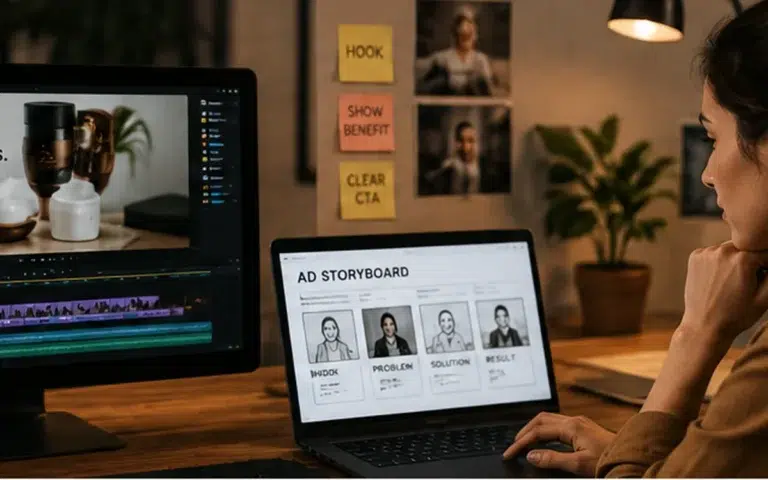
The first confirmed application is an AI storyboard generator, a tool that turns a script into a visual, comic-book-style blueprint of each scene before cameras roll.
Scott Belsky, who leads A24’s technology division A24 Labs, told the Wall Street Journal that most AI video companies “mistakenly advertised their products as a means to make films cheaper and faster,” and that A24’s tools will instead be built to “preserve creative control and support risk-taking.” He was direct about the distinction: the new tools “won’t look anything like the prompted generation type of AI that people feel uncomfortable with” (Variety, June 22, 2026). Beyond storyboarding, the partnership’s stated scope extends to scriptwriting and text analysis, cinematography, visual effects design, editing, and production management, applied incrementally as filmmaker feedback shapes each tool (Deadline, June 2026).
How Does This Fit the Broader 2026 Trend of Studios Partnering With AI?
Google and A24 is one of at least four major studio-AI deals in 2026, and each one handles creative control differently, which is itself useful data.
| Studio | AI Partner | Deal Structure | Status as of Mid-2026 |
|---|---|---|---|
| A24 | Google DeepMind | $75 million investment, non-exclusive research partnership, no access to A24’s library | Active; announced June 2026 |
| Disney | OpenAI (Sora) | $1 billion investment tied to character licensing for a text-to-video app | Collapsed; Sam Altman confirmed “the deal is not moving forward,” March 2026 |
| Lionsgate | Runway AI | Expanded equity partnership to develop new IP and AI-assisted shows from existing franchises | Active; expanded in 2026 |
| Netflix | InterPositive (Ben Affleck’s startup) | Acquisition of a filmmaker-focused AI tools company | Active; acquired in 2026 |
Disney’s collapse is the clearest cautionary data point: a deal built around licensing characters into a generative tool fell apart within months. The deals still standing, A24’s, Lionsgate’s, and Netflix’s, all keep a human creative team in the loop rather than treating AI as a replacement for one (Variety, June 22, 2026).
What Does A24’s Approach Signal for Small Business Video?
A24’s insistence on tools that preserve creative control, even while accepting $75 million from one of the largest AI labs in the world, signals that the “prompt it and publish it” version of AI video is losing credibility at every level of the industry, not just among small business owners who already suspected it.
This matters because small business video marketing has spent the last two years being sold the same pitch Belsky rejected: AI video as a way to make content cheaper and faster, with speed and volume standing in for quality and trust. A24, with far more AI budget and technical access than any small business will ever have, chose the opposite framing. Sophia Shin, A24’s spokesperson, told Wired the studio doesn’t “necessarily love” most current generative AI output and structured the deal specifically so filmmakers would have “an active hand in shaping new tools and workflows” rather than having tools handed to them (Deadline, June 26, 2026). That is the same principle behind humanized storytelling: the story and creative direction come first, AI production supports it, not the other way around.
Is This Proof That Businesses Need Bigger Budgets to Use AI Video Well?
No. The Google and A24 deal actually argues against that idea.
If bigger AI budgets automatically produced better AI video, Disney’s billion-dollar Sora deal would still be standing instead of collapsing within months. What separated the deals that held together from the one that didn’t was not money, it was whether a real creative team kept control of the story. A24 had $75 million in new resources and still built the partnership around protecting creative judgment, not around generating more content faster. A small business does not need a seven or eight-figure AI budget to apply the same principle: a documented story, kept under the owner’s control, produced with AI rather than replaced by it.
Practical Application: What to Take From the Google and A24 Deal
Whether or not this specific news ever comes up with a customer, the underlying lesson applies to any small business using AI video:
- Treat AI as production support, not the creative decision-maker. A24 explicitly built its deal around this distinction; the same principle scales down to a single-location business.
- Be wary of any AI video pitch that leads with “cheaper and faster.” Scott Belsky, one of the people actually building these tools, named that framing as the industry’s core mistake.
- Keep your story and footage under your own control. A24 kept its film library out of the deal for a reason; a business should own its scripts, footage, and brand story the same way, not hand them entirely to a single AI platform with no export path.
- Watch which studio-AI deals last, not just which ones get announced. The Disney-OpenAI collapse versus the A24, Lionsgate, and Netflix deals still standing is a live signal for what actually works, worth revisiting periodically.
- Prioritize the story you’re producing over the tool producing it. None of the surviving deals are being sold on tool novelty alone; they’re built around real creative teams with something specific to say.
Your Next Step
If the headline made you wonder whether your business needs a bigger AI budget to compete, the honest answer is no, it needs a clearer story and a human-led approach to producing it. A Free Film Form shows what that looks like for your specific business, built the same way A24 insisted its own tools be built: story first, AI in support.
FAQ
What did Google actually invest in A24 for?
Google’s DeepMind unit invested roughly $75 million in A24 in June 2026 for a non-exclusive research partnership to co-develop AI filmmaking tools, starting with an AI storyboard generator, with A24 retaining full creative control and keeping its existing film library out of the deal.
Does the A24 deal give Google access to A24’s movies?
No. The deal explicitly does not give Google access to A24’s content library or its data. It is a forward-looking tools partnership, not a licensing or content deal.
Why did A24 agree to work with Google if it doesn’t love AI content?
A24 spokesperson Sophia Shin said the studio doesn’t “necessarily love” current generative AI output but would “rather have a seat at the table than on the sidelines,” framing the deal as a way to shape the tools filmmakers will eventually be asked to use rather than have them imposed later.
What does this mean for small businesses using AI video?
It means bigger AI budgets are not the differentiator. A24 had access to significant new resources and still built its partnership around preserving creative control rather than generating more content faster, the same principle a small business can apply with a documented story and a human-led approach to AI production.
Are other major studios doing similar AI deals?
Yes. Lionsgate expanded its equity partnership with Runway AI and Netflix acquired Ben Affleck’s AI filmmaking startup InterPositive in 2026, while Disney’s $1 billion deal with OpenAI’s Sora collapsed the same year, illustrating that deal structure and creative control matter more than deal size.
Key Takeaways: What Changes for Your Business
- Google’s $75 million investment in A24 is a research partnership for AI production tools, not a content or licensing deal, and A24 keeps full creative control.
- A24’s own technology lead rejected the “cheaper and faster” pitch that defines most AI video marketing, insisting instead on tools that preserve creative judgment.
- Of the four major 2026 studio-AI deals, the one built purely around content licensing (Disney and OpenAI) collapsed, while the ones keeping creative teams in control are still active.
- For small business video marketing, the lesson is not about budget. It is that a documented, human-led story with AI in a supporting role outperforms prompt-and-publish content at every scale.
- Your next move is the same one A24 made: put the story first, and let AI production support it.
See What Story-First AI Video Looks Like for Your Business
Even Hollywood’s most trusted studio built its AI strategy around protecting the story, not speeding it up. Your business can work the same way. Get Your Free Film Form
Your story works while you work.
0 conversations