|
Key takeaways • Write the buyer question and proof before choosing a video generator. • Assign one human owner to each claim, source, asset, and approval. • Use AI for drafts and versions; verify every factual or client-specific detail. • Choose one primary format and channel, then make only purposeful variants. • A September 24 HeyGen survey is a timely signal about publishing friction, not proof of universal results. |
What AI video production means for a service business
AI video production is the use of generative and assistive software across planning, scripting, visual creation, editing, voice, captions, and distribution preparation. It is a production method, not a single button. For a small business, the useful measure is whether a prospective customer can understand a credible promise and take a sensible next step. A polished render cannot compensate for a vague offer or an unsupported claim.
A common myth is that replacing a camera day with an AI tool eliminates production work. It moves much of that work into creative direction, source selection, prompt and asset review, rights checks, and final approval. The company still needs to know who the film is for, why the viewer should believe it, and what it may responsibly say.
A timely signal: the bottleneck after filming
In a September 24, 2026 release, HeyGen reported results from a survey of more than 1,000 small-business owners and solopreneurs. It said 71.6% had filmed a business video and decided not to post it. This is vendor-reported survey evidence, with its own sample and question framing; it does not establish the rate for every small business. It does point to a practical question: what approval or confidence problem stops a draft becoming a published asset?
A proof-first process answers that question before production. The team names its evidence, checks that the story still matches the actual service, and identifies one person who can say yes to release. That is more actionable than treating a new generator as a cure for hesitation.
Start with a claim and its proof
Write one buyer question in ordinary language: “How will an IT provider keep our team working during a move?” or “What happens after I request a consultation?” Then draft a one-sentence answer. Identify what can substantiate it: a documented process, an approved demonstration, a customer quote with permission, a public specification, or a named expert. If the proof is unavailable, soften the claim or choose another angle.
|
Claim type |
Suitable proof |
Human owner |
|---|---|---|
|
What the service does |
Approved process or first-hand demonstration |
Service lead |
|
Outcome or performance |
Specific, attributable evidence and caveats |
Client/account owner |
|
Customer experience |
Consented quote or approved story |
Relationship owner |
|
Visual representation |
Rights and authenticity review |
Creative lead |
The seven-gate production workflow
- Buyer question: select one audience and one decision the video should help them make. Record the intended channel and next action.
- Source proof: build a small evidence folder and mark which claims are verified, illustrative, or off limits. Obtain consent for client material.
- Script: write a plain spoken opening, problem, evidence, and invitation. Let AI propose variations, then remove claims it cannot support.
- Format: choose the smallest useful form, such as a founder explanation, process walkthrough, customer story, or short social cut.
- Production: create only the footage, graphics, voice, and captions needed for that form. Keep a record of asset origins and licenses.
- Human review: check factual accuracy, pronunciation, identity, accessibility, visual implication, music and voice rights, and brand tone.
- Release and learning: approve the final version, publish in the intended context, record feedback, and revise the next brief.
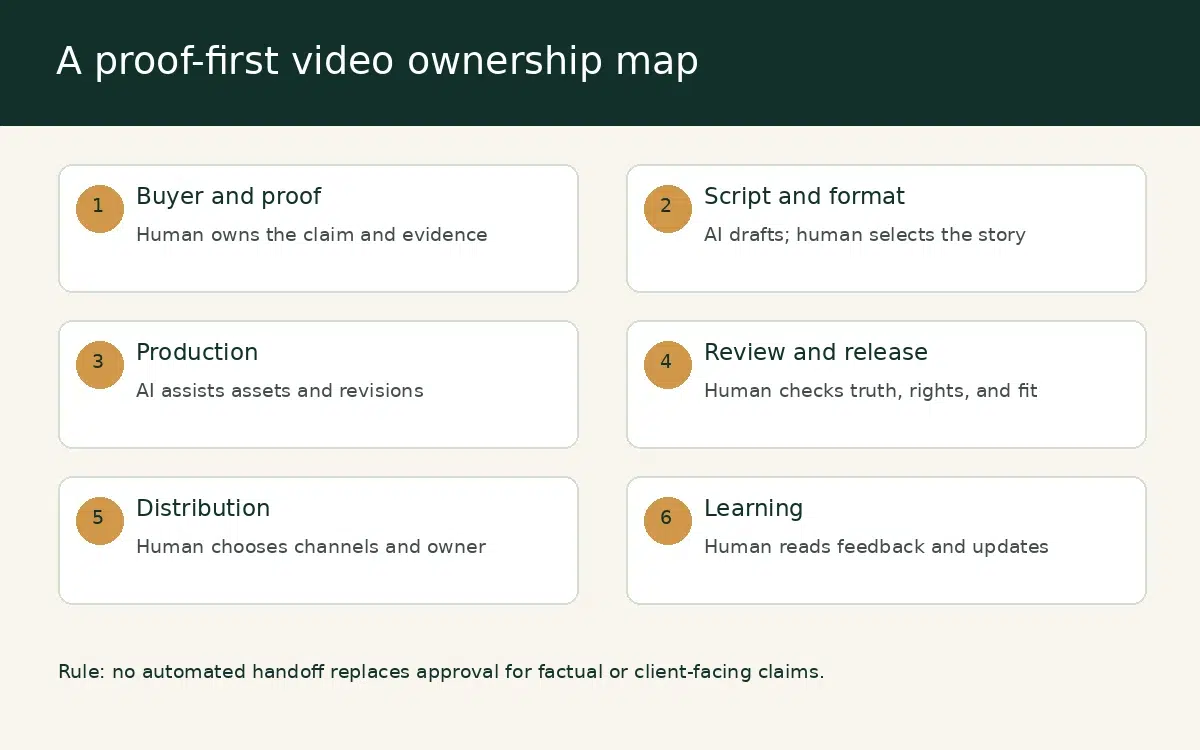
The handoff map makes ownership visible from evidence through learning.
Which parts can AI accelerate?
|
Task |
Good AI use |
Required human judgment |
|---|---|---|
|
Research and outline |
Cluster questions and draft a structure |
Confirm source quality and buyer relevance |
|
Script and storyboard |
Generate alternate hooks and scene orders |
Choose truthful claims and a coherent story |
|
Visual and audio assets |
Make draft scenes, cleanup, captions, voice options |
Check likeness, rights, accessibility, and implication |
|
Editing and versions |
Resize, trim, subtitle, and produce variants |
Approve pacing, accuracy, and each channel context |
|
Distribution |
Prepare descriptions and release checklist |
Own publication, response, and learning |
The split is about responsibility, not whether a tool can perform the action. A transcript can be auto-captioned and still need a person to catch a product name. A generated scene can look realistic and still imply an actual facility, client, or result that the business does not have.
Example: a GTA managed IT provider
Suppose a Toronto-area managed service provider wants a 45-second film about onboarding a new office. The buyer worries about downtime and unclear handoffs. The team maps its documented intake, inventory, access, and cutover steps. AI helps turn the approved process into a storyboard and creates a nonliteral transition visual. A service lead checks each operational statement; the account lead approves any client reference; the creative lead labels illustrative imagery appropriately. The ending invites a conversation about the buyer’s own move, without promising zero downtime.
The first version might be a concise homepage explainer. A shorter social cut can reuse the same verified core, but its opening and captions need another review because context changed. The purpose of the variant is to answer the same buyer question faster, not to generate a volume of interchangeable posts.
Mistakes that stall publication
- Starting with tool features instead of the buyer’s decision; the draft becomes a demonstration of software rather than service.
- Treating generated imagery as documentary footage; viewers may infer real people, facilities, or outcomes.
- Using an unapproved customer detail or testimonial in a prompt or final film.
- Writing a result claim first and searching for supporting proof afterward.
- Making every platform version at once, which multiplies review work before the core story is sound.
- Leaving approval to a vague group; no one knows who can release the film.
A 30-minute brief before any production
- Audience and buyer question: one sentence each.
- Single promise: one answer the business can responsibly make.
- Proof: source, owner, permission status, and any caveat.
- Format: duration, aspect ratio, channel, and next action.
- Assets: what can be used, what must be created, and what must remain illustrative.
- Review: named factual, rights, and final release owners.
If those six fields remain blank, production is premature. A short brief also gives an editor or AI operator useful constraints. The team can compare the finished cut against the same brief instead of debating whether the output merely “looks professional.”
Frequently asked questions
Do we need to appear on camera?
No. A process demonstration, screen walkthrough, or carefully labeled illustrative visual may be a better fit. Choose the format that proves the point.
Can AI write the entire script?
It can draft a script. A subject expert must check the claims, examples, and promise before production.
How do we handle generated people or voices?
Check permissions and the risk that viewers will mistake a generated representation for a real employee or customer. Use clear context where needed.
What should we measure first?
Track whether the intended viewer understands the offer and takes the next relevant action. Interpret channel metrics in light of audience and distribution.
When should we create several cuts?
After the core story and proof pass review. Each new context needs captions, opening, and claims checked again.
Is a faster render a better production process?
Only if the resulting video remains truthful, useful, accessible, and approved. Speed is a production input, not the buyer outcome.
The next step
If your service has a real story but the proof and production handoffs are unclear, start with a focused film brief.
Related Social Scion reading
- AI film production rules for 2026
- AI video creation tools across the workflow
- Humanized storytelling for business visibility
Sources and verification
Editorial package notes
Suggested meta title: AI Video Production for Small Business | Proof-First Workflow
Meta description: Plan AI video production around buyer questions, credible proof, clear ownership, human review, and a practical seven-gate workflow for small service teams.
Focus keyword: ai video production for small business. Schema: Article. Cannibalization: this page owns production decision and accountability; the existing tools article owns tool selection, and the film-rules article owns governance.

0 conversations