The production problem is real: your happiest customer may agree to a testimonial and still never record it. Scheduling, camera discomfort, privacy limits and editing effort can turn a willing advocate into an unfinished task.
AI can remove some of that friction. It cannot supply the truth. An AI video testimonial is usable only when the identity, words, permission and claimed outcome survive a clear audit from first request to final cut.
Key Takeaways
|
A testimonial is evidence, not just content. Production quality cannot compensate for an unverified customer claim.
|
The New Trust Question Is Not Was AI Used
On Sep 28, 2026, a research review titled Trustworthy synthetic visual media argued that no single marker can establish media trust in every situation. Evidence has to match the question, reach the person making the decision and remain open to correction. The paper is a recent preprint, so it should be treated as research context, not settled law or an industry standard.
That distinction matters for testimonials. A provenance marker may help show how a video was generated or edited. It does not prove that the customer had the stated experience, approved the wording or agreed to the final use. The useful record sits across the whole workflow: source quote, authorization, production treatment, claim support and final sign-off.
Social Scion's practical interpretation: the more a video resembles first-person evidence, the stronger its evidence chain must be. AI may replace production effort. It must not replace the customer's agency.
What AI Video Testimonials Are
An AI video testimonial is a customer endorsement in which artificial intelligence materially assists or creates part of the delivery, such as scripting support, transcript cleanup, translation, dubbing, editing, background repair, voice synthesis or a consented digital likeness. The testimonial remains legitimate only when the underlying experience and claims belong to a real customer and the production treatment is authorized.
This is different from a synthetic spokesperson reading marketing copy. A spokesperson explains the business's message. A testimonial presents a customer's experience as evidence. That higher trust burden changes what must be documented.
A current filmed alternative shows the other end of the spectrum. Sayso describes a managed process with local crews, remote direction, review and delivery. Its page also says AI helps structure production while humans handle the interview and polish. Those are vendor descriptions, not independently verified performance claims, but they illustrate an important point: AI assistance does not require replacing the customer on camera.
The Myth That a Customer Makes Every Format Authentic
A real customer can still appear in a misleading testimonial. Their quote may be rewritten beyond what they meant. A result may be presented without scope. Old consent may be reused for a new paid campaign. An edit may combine answers in a way that changes the implication. Camera capture is not automatic proof.
The reverse is also true. A synthetic delivery can communicate a genuine, customer-approved review if every sentence is traceable, the identity treatment is authorized, the audience is not misled about what was recorded and the customer approves the exact final cut. The decisive question is not whether AI touched the asset. It is whether AI crossed into the evidence layer.
The Social Scion synthetic video trust rules make the same production-layer distinction: approved delivery can be synthetic while the source truth remains human and verifiable.
Choose the Format by Trust Burden
|
Format |
Best fit |
What stays real |
Main risk |
Decision rule |
|---|---|---|---|---|
|
In-person filmed |
High-emotion or sensitive stories |
Customer performance and setting |
Scheduling and camera burden |
Choose when presence itself is evidence |
|
Remote filmed |
Distributed customers and faster capture |
Customer voice and live delivery |
Uneven picture or sound |
Choose when access matters more than polish |
|
AI-assisted edit |
Real footage that needs cleanup or versions |
Original recording and meaning |
Edits can alter context |
Choose when the source footage already carries the story |
|
Consented digital likeness |
Approved review with severe filming friction |
Experience, words and permission |
Viewers may assume a real recording |
Choose only with scoped consent and clear treatment |
|
Synthetic presenter quoting customer |
Illustrative summary where identity is secondary |
Attributed quote and source |
Can feel like manufactured proof |
Prefer direct attribution and avoid impersonation |
Table 1. Choose the least synthetic format that removes the real production bottleneck without weakening the evidence.
The Six Gate Testimonial Standard
Use these six gates as a stop-or-publish decision. They are deliberately stricter than a creative approval checklist because customer proof can affect sales, reputation and the customer's own standing.
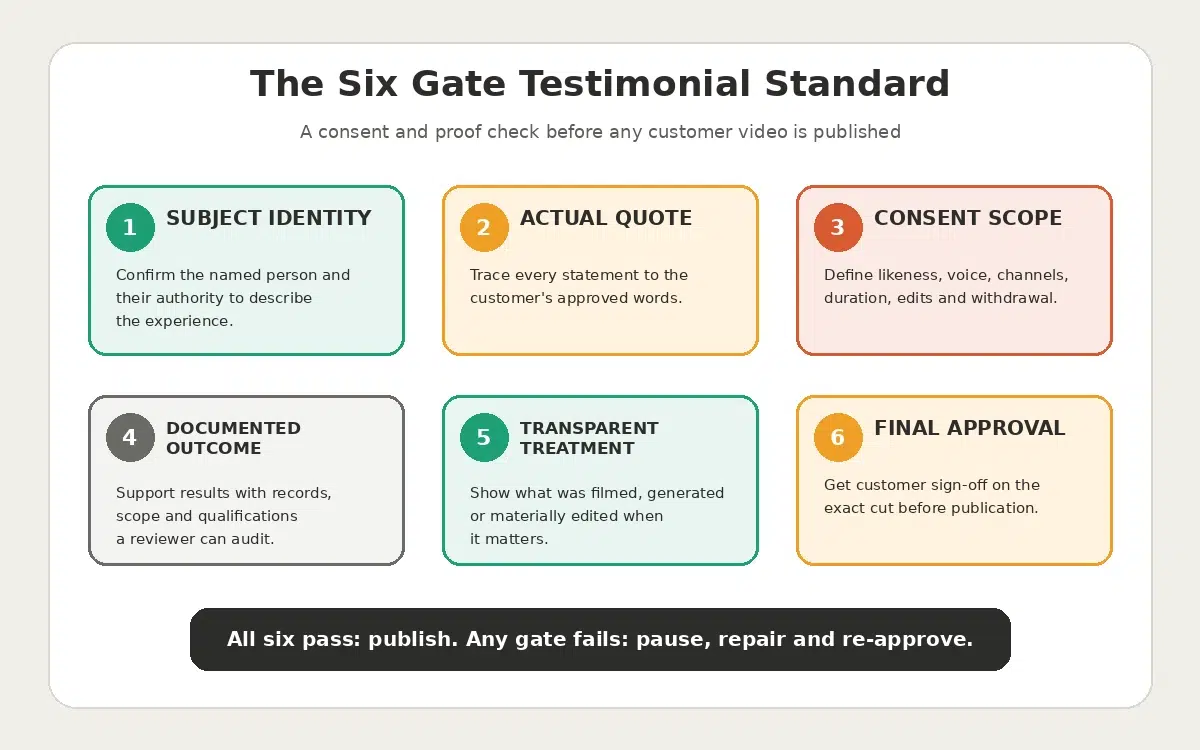
Figure 1. All six gates must pass. A failure pauses the workflow rather than being hidden by better editing.
Gate 1 Subject identity. Confirm the person's name, role and authority to describe the experience. If the story involves confidential work, decide whether their identity can be public or whether a different proof format is safer.
Gate 2 Actual quote. Keep an approved source transcript or written review. Editing may improve clarity, but it must not change meaning, add certainty or turn a narrow result into a broad promise.
Gate 3 Consent scope. Document what is approved: script, face, voice, avatar, generated scenes, channels, paid promotion, geography, duration, edit rights and withdrawal or expiry terms. A yes to an interview is not a permanent license for every future use.
Gate 4 Documented outcome. Support the claimed result with records that match its scope. Distinguish a customer's perception from a measurable outcome. If the evidence is incomplete, qualify the language instead of filling the gap.
Gate 5 Transparent treatment. Identify what was filmed, synthesized, translated or materially altered when that distinction could change how a reasonable viewer interprets the proof. Check the current disclosure rules of every publication channel.
Gate 6 Final customer approval. Send the exact final cut, caption and intended placement to the customer. Record approval after all edits. The customer's right to correct or stop publication is part of the evidence chain.
A Seven Step Consent First Workflow
- Define the reader decision. Write the single decision the testimonial should help a buyer make. For an MSP, that might be whether the provider can manage an onboarding transition with clear communication, not whether the company is simply pleasant to work with.
- Collect the customer's source truth. Gather the original review, interview transcript, project scope and any records supporting the outcome. Mark each claim as verified, subjective or not yet supported.
- Choose the minimum necessary production treatment. Start with real filmed or remote capture when the customer's human performance is the proof. Use AI editing, translation or a consented likeness only when it solves a defined bottleneck.
- Write from approved evidence. Shape a concise narrative around the customer's before state, decision, experience and result. Preserve their vocabulary. Do not improve the story by inventing drama, certainty or metrics.
- Secure scoped consent before generation. Show the customer the intended script, format, channels and identity treatment. Explain what AI will do in plain language. Record a clear approve, revise or decline choice.
- Run the evidence and reality checks. Review the video against the six gates. Ask a person who did not build it what they believe was filmed and what they think the customer is claiming. Repair any mismatch.
- Get final approval and preserve the record. Send the exact cut and surrounding copy for sign-off. Store the source quote, consent terms, final approval and publication locations together so future teams do not reuse the asset outside its scope.
Practical Exercise Build a Testimonial Evidence Pack
In 15 minutes, create a one-page evidence pack before you brief a producer or open an AI video tool. The pack should contain:
- Customer identity and role, plus the relationship to the work described.
- Exact approved quote or transcript excerpt.
- Outcome evidence, with scope, date range and qualifications.
- Permitted use of face, voice, avatar, script, channel, paid media and duration.
- Production treatment: filmed, AI-assisted edit, translation, dubbing or consented synthetic likeness.
- Required disclosure or context for each channel.
- Final approver, expiry or review date, and a withdrawal contact.
Optional AI prompt. Review this testimonial evidence pack. Separate VERIFIED SOURCE TRUTH from PRODUCTION TREATMENT. Flag any claim without support, any consent term that is vague, and any scene or line a reasonable viewer could misinterpret as directly filmed evidence. Do not invent names, quotes, dates, metrics, motivations, customer details or outcomes. If evidence is missing, mark it [NEEDS SOURCE] instead of filling the gap.
When to Keep It Manual and When to Use a Specialist
Stay manual when the performance is the proof
Film the real person when emotion, vulnerability, clinical sensitivity, community identity or a complex lived experience carries the value. The pauses, uncertainty and natural delivery may matter more than production consistency.
Use AI assistance when the truth is already captured
AI-assisted transcription, silence removal, reframing, captioning, translation and versioning can reduce effort while preserving the source recording. Keep a reviewer responsible for whether the edit changes meaning.
Use a consented likeness only for a defined constraint
A digital likeness can make sense when the customer genuinely wants to participate but cannot film, the script is fully approved, the use is limited and the presentation will not imply an event that never happened. It should solve a production constraint, not manufacture social proof at scale.
Buy software only after the governance works
A platform subscription is justified when repeated approved testimonials or multilingual versions create a measurable workflow bottleneck. Before purchase, evaluate identity controls, consent records, asset deletion, data retention, commercial rights, collaboration, version history, watermarking or provenance support and export quality. The expensive failure is rarely one unused month. It is an untraceable identity asset or a customer dispute.
Common Mistakes That Break the Evidence Chain
Starting with a polished script. A writer can smooth away the customer's real language and introduce claims the evidence does not support. Start with the source quote and edit visibly.
Treating consent as one checkbox. Permission to create an avatar does not automatically cover every script, campaign, channel or future edit. Scope the use and renew approval when the use changes.
Hiding the production treatment. If a viewer could reasonably believe the customer delivered a line on camera when they did not, missing context can damage the trust the testimonial was meant to build.
Using vendor outcomes as independent proof. A production company case study describes its own process and success. It can illustrate a workflow, but it should not be treated as neutral validation of the format.
Approving the script but not the cut. Generated gestures, pronunciation, B-roll and timing can change how the words feel. The final asset needs a separate customer approval.
Scaling before one example survives scrutiny. Producing a library of synthetic testimonials magnifies weak governance. Prove the recordkeeping and review process on one asset first.
A Service Business Example
An MSP wants a customer to describe a difficult onboarding transition. The customer has already written that communication was clear and disruption was limited, but confidentiality rules prevent filming inside the workplace. The MSP should not generate a photorealistic office reenactment and present it as documentary footage.
A defensible option is to keep the written review as the source, verify the onboarding scope, obtain approval for a concise script and choose either a real remote voice recording over abstract visuals or a clearly contextualized, consented digital delivery. The customer approves the script, identity treatment, final cut and placement. The outcome stays qualified to that project. The production burden falls, but the customer's control does not.
Frequently Asked Questions
What makes an AI video testimonial authentic
It is authentic when a real customer's experience, words and permission remain traceable through the final asset. Visual realism alone is not authenticity.
Can AI write the testimonial script
AI can organize approved source material, but it should not invent quotes, outcomes or emotional language. The customer must approve the exact wording.
Do AI video testimonials require disclosure
Disclosure depends on the treatment, channel and jurisdiction. If realistic AI makes a person appear to say or do something they did not record, check current platform rules and add context that prevents a reasonable viewer from being misled.
Is a customer avatar safer than a synthetic actor
Not automatically. A customer avatar carries stronger identity and consent obligations because viewers may interpret it as first-person evidence. A synthetic presenter avoids impersonation but can still misstate the customer's experience.
What evidence should a small business keep
Keep the source quote or transcript, identity confirmation, consent scope, claim support, production notes, disclosure decision, final cut and final customer approval in one accessible record.
When is traditional filming still the better choice
Traditional filming is better when the human performance, setting or emotional nuance is itself part of the proof. AI should not replace the irreplaceable part of the story.
The Standard Is Simple Even When the Workflow Is Not
A trustworthy testimonial lets the customer remain the protagonist. The business can supply context, production support and a clear approval path. AI can accelerate structure, editing, translation and delivery. It cannot borrow credibility the customer did not give.
The practical standard is therefore stricter than visual quality: know who is speaking, preserve what they actually said, document the permission, support the outcome, explain the treatment when it matters and obtain final approval. When every gate passes, AI has reduced friction without reducing truth.
Want to see how your real business story can become a humanized film without living on camera? Get your Free Film


0 conversations