Key Takeaways
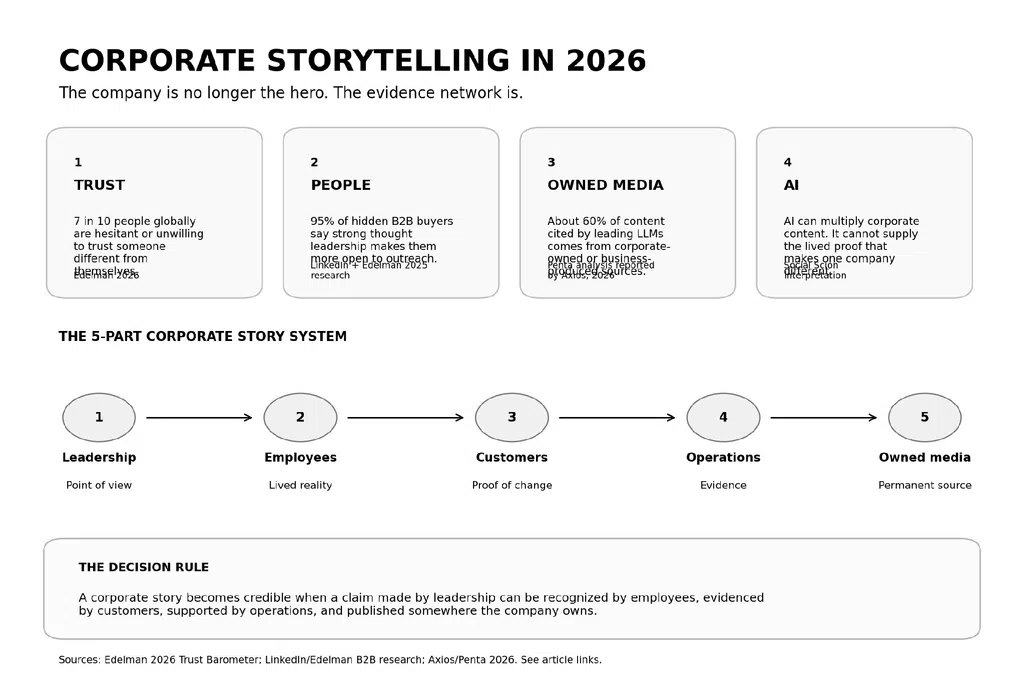
| Corporate storytelling in 2026 is not the company telling a polished version of itself. It is a system that connects leadership point of view, employee reality, customer proof, operational evidence, and owned publishing. Trust is harder to transfer across unfamiliar groups. Edelman’s 2026 research says seven in 10 people globally are hesitant or unwilling to trust someone different from themselves, which makes familiar and credible human voices more valuable. B2B buyers increasingly evaluate companies through people and ideas before they respond to sales. LinkedIn reports that 95% of hidden buyers are more open to outreach from companies producing strong thought leadership. Owned corporate stories matter to AI visibility as well as human trust. Axios reported Penta analysis estimating that about 60% of content cited by major LLMs comes from corporate-owned or business-produced sources. AI should help organize, adapt, visualize, and distribute a corporate story. It should not invent the employee experience, customer outcome, leadership conviction, or operational proof that makes the story credible. |
|---|
Figure 1. Corporate storytelling in 2026: trust, people, owned media, and AI now converge around one evidence system.
Corporate Storytelling Has a New Job in 2026
Corporate storytelling used to be treated as a communications exercise: define the company story, polish the language, align the leadership team, and repeat the message across channels. That model assumes the company is the primary narrator and the audience mainly decides whether the message is persuasive.
That assumption is weakening. A customer can now compare the corporate website with employee posts, reviews, creator commentary, analyst content, AI answers, product communities, and the language used by leaders in public. The story is no longer one controlled message. It is the pattern people recognize across many pieces of evidence.
This is why the 2026 trust environment matters. The 2026 Edelman Trust Barometer reports that seven in 10 people globally are hesitant or unwilling to trust someone different from themselves. Edelman’s June 2026 analysis of brand storytelling describes audiences as overwhelmed by information, skeptical of automation, and increasingly selective about where they place trust.
At the same time, business buyers are using human expertise as a way to judge organizations before they ever speak to sales. LinkedIn’s 2026 B2B marketing research says 95% of hidden buyers are more open to outreach from a company that produces strong thought leadership. The implication is simple: people want to know whether the humans inside the company understand their world.
And there is now a machine audience too. Axios reported in March 2026 that Penta Group analysis found roughly 60% of content cited by leading large language models came from corporate-owned or business-produced sources. Clear, evidence-rich owned media is becoming part of how a company is represented in AI answers.
Corporate storytelling therefore has a larger job: help people, buyers, employees, and AI systems arrive at the same truthful understanding of what the company believes, does, proves, and changes for the people it serves.
What Corporate Storytelling Actually Means
Corporate storytelling is the practice of turning a company’s real decisions, people, customer outcomes, operating evidence, and point of view into connected narratives that help audiences understand what the organization stands for and why that position is believable.
The word corporate can make the discipline sound larger and more formal than it needs to be. The same principle works for a 20-person professional-services firm, a family business, a technology company, or a multinational organization. The difference is that corporate storytelling has to reconcile more voices and more proof than a single campaign story.
Corporate storytelling vs. brand storytelling
Brand storytelling is the broader system of meaning around the brand: identity, values, customer aspiration, history, category position, and emotional world. Corporate storytelling is more accountable to the organization behind that brand. It must explain decisions, people, expertise, culture, progress, responsibility, and evidence across internal and external audiences.
Corporate storytelling vs. content marketing
Content marketing is a distribution and demand discipline. Corporate storytelling supplies the narrative source material that makes those assets coherent. A company can publish a high volume of content without having a clear corporate story. That usually produces topic coverage without accumulated meaning.
This is the same distinction Social Scion makes in How to Build a Storytelling Marketing Strategy in 2026: the story should be documented before the content calendar starts multiplying it.
Corporate storytelling vs. internal communications
Internal communications helps people understand what is happening inside the company. Corporate storytelling goes one layer deeper and connects what is happening to a shared narrative people can repeat. The test is not whether employees received the announcement. It is whether their lived experience supports the story leadership wants the market to believe.
The Five-Part Corporate Story Evidence System
A useful corporate story can be tested as an evidence chain. Each layer should support the next one. If one layer contradicts another, more polish usually makes the credibility problem worse.
Figure 2. The corporate story evidence stack: the visible narrative is strongest when every layer underneath it can support the claim.
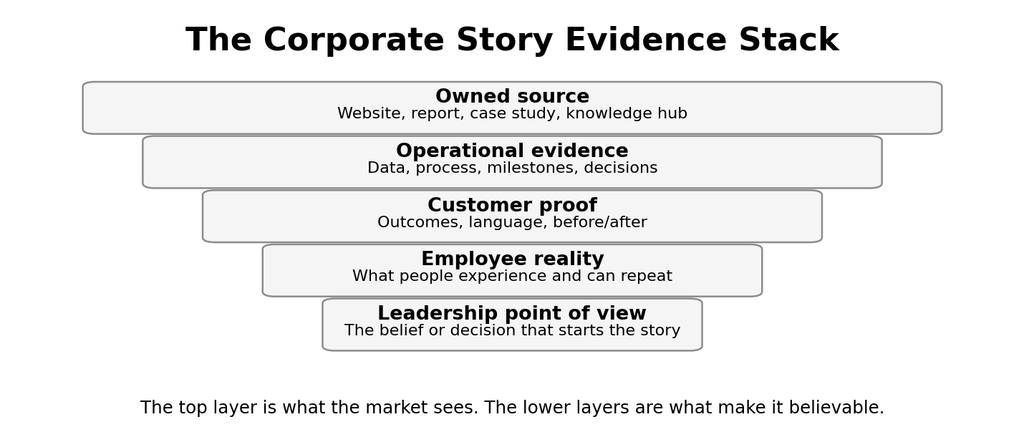
1. Leadership point of view
A corporate story needs an earned belief, not a generic value. What has leadership learned, chosen, rejected, changed, or committed to because of actual experience? A point of view becomes useful when it creates a decision the company can be held accountable to.
2. Employee reality
Can employees recognize the story in the way the organization actually works? Culture statements become credible when people can point to rituals, decisions, customer moments, policies, or tradeoffs that make the statement real.
3. Customer proof
What changed for a customer because the company exists? Testimonials become corporate storytelling when they contain context, tension, decision, change, and evidence, not just praise.
4. Operational evidence
Metrics, milestones, product choices, delivery processes, research, and documented actions stop the story from floating above reality. A claim such as “customer-first” is weak until the operating model shows what the company does differently because of it.
5. Owned source
The story needs a permanent, crawlable home. A corporate website, article, case study, report, FAQ, or knowledge hub gives people and AI systems a stable source to return to instead of relying entirely on rented social reach.
| The corporate storytelling test If leadership says it, employees recognize it, customers can evidence it, operations support it, and the company publishes it clearly, the story is probably strong enough to travel. |
|---|
The Myth: Corporate Storytelling Is the CEO Origin Story
Founder and CEO stories can be powerful. They are not the whole corporate narrative.
The myth survives because origin stories are easy to package. There is a protagonist, a struggle, a breakthrough, and a company. But a mature organization needs more than a single heroic voice. If every corporate story begins with leadership, customers and employees become supporting characters in a story supposedly about them.
A stronger model treats leadership as one source of meaning and the organization as a network of lived evidence. This matters even more in the current trust environment. Edelman’s 2026 storytelling trends argue that audiences are retreating into smaller trusted networks. The corporate voice therefore becomes more credible when it is corroborated by recognizable human voices rather than endlessly repeated by the company itself.
The correction is not “make corporate content less polished.” It is “make corporate claims more provable.” A beautifully produced film can be authentic. A shaky employee video can still be scripted. Production style is not evidence.
3 Tools That Solve Different Parts of Corporate Storytelling
No software can create the truth of a corporate story. The useful tools reduce friction around three separate jobs: packaging the narrative, collecting human proof, and turning that proof into usable video. Capabilities and pricing below were verified against official vendor pages; G2 is used as an independent sentiment layer where review depth is sufficient to be informative.
| Tool | Best for | Current pricing signal | G2 signal | Main strength | Main tradeoff |
|---|---|---|---|---|---|
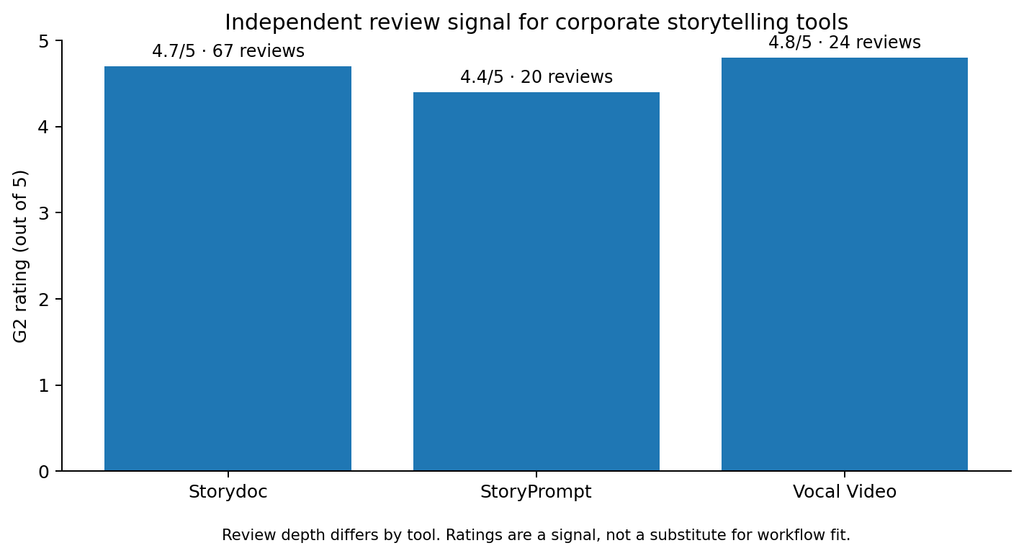
| Storydoc | Interactive corporate decks, reports, proposals | Starter $19.80/mo annually; Pro $36/mo annually | 4.7/5 · 67 reviews | Turns static corporate material into trackable interactive stories | Customization and cost are recurring review concerns |
| StoryPrompt | Collecting employee/customer video proof asynchronously | Free; Starter $49/mo; Pro $99/mo monthly | 4.4/5 · 20 reviews | Easy collection, transcription, stitching and Walls of Love | Smaller review base; free videos are watermarked/SD |
| Vocal Video | Structured testimonial and employee-story production | Free; Essential $99/mo; Pro $149/mo annually | 4.8/5 · 24 reviews | Question-led remote collection plus polished branded output | Advanced editing flexibility can be limited |
Figure 3. G2 review signal for the three tools. Review depth is useful context, not a universal quality score.
Storydoc: best for making corporate material feel like a story, not a PDF
Storydoc is built around interactive web presentations rather than traditional static slides. Its current product includes AI deck generation, AI text and image assistance, analytics, personalization, integrations, and interactive content. Storydoc’s official pricing currently lists Starter at $19.80 per month billed annually and Pro at $36 per month billed annually, with different limits for active documents, AI credits, analytics, and integrations.
Its G2 profile currently shows 4.7/5 from 67 reviews. Recurring positives include ease of use, presentation quality, intuitive design, and support. Recurring negatives include pricing and limits around customization or templates.
Social Scion assessment: use Storydoc when the story already exists and the problem is presentation. It can make a corporate report, proposal, case-study narrative, or executive story easier to consume and measure. It should not be the place where the company invents what it believes.
StoryPrompt: best for collecting a distributed human voice
StoryPrompt is useful when the corporate narrative needs more people inside it. Its current pricing page offers a free tier with 15 responses, two-minute video responses, automatic transcription, video stitching and editing, and a Wall of Love. Paid plans add higher response limits, HD, brand control, embeds, AI summaries, team features, workflows, webhooks, and API access.
The StoryPrompt G2 profile currently shows 4.4/5 from 20 reviews. That is enough to provide useful directional evidence, but it is still a smaller review base than mature enterprise platforms. Reviews emphasize easy testimonial collection and organization, with limitations depending on download and workflow needs.
Social Scion assessment: StoryPrompt is useful when the bottleneck is not writing but access. If customer, partner, or employee stories are scattered across meetings and inboxes, a structured asynchronous capture process can create the raw material the corporate narrative is missing.
Vocal Video: best for turning proof into polished corporate video
Vocal Video focuses on collecting, editing, and publishing customer and employee video remotely. Its collectors let participants answer questions without scheduling a formal interview, then apply branded elements, music, subtitles, and editing. Vocal Video pricing currently includes a free plan, Essential at $99 per month billed annually, Pro at $149 per month billed annually, and higher Scale and Enterprise tiers.
Its G2 profile currently shows 4.8/5 from 24 reviews. Review themes repeatedly mention ease of use, questionnaire-driven collection, professional output, and time savings. Editing precision and higher-tier feature requirements appear among the limitations.
Social Scion assessment: Vocal Video is strongest when the company has real proof but lacks a repeatable production workflow. It turns interviews into assets. It does not replace the need to ask questions that reveal a story rather than collect generic praise.
How to Build a Corporate Story in 8 Steps
1. Start with the decision, not the slogan
Find a decision that reveals what the company believes. A real decision contains a tradeoff. “We value innovation” is not a story. “We stopped selling our highest-margin service because customers were using it for the wrong problem” is the beginning of one.
2. Find the person who experienced the consequence
Corporate stories become easier to understand when they are experienced by someone: a customer, employee, partner, founder, community member, or team. The person is not decoration. They are the point where an abstract corporate claim becomes observable.
3. Capture the before-state
What was true before the decision, product, change, or intervention? Capture exact context, not adjectives. “The process was frustrating” is weak. “Customers waited five days for an answer that required 20 minutes of work” is a usable before-state.
4. Identify the tension or tradeoff
What made the situation difficult? What would have happened if nothing changed? Strong corporate storytelling includes the constraint the company had to work through, not only the polished result.
5. Collect proof before drafting
Gather customer language, employee observations, data, milestones, screenshots, timelines, process changes, and documented decisions. Separate what happened from what the company wishes the story meant.
6. Build the simplest true arc
Use Before → Tension → Decision → Change → Proof. If the story needs six paragraphs of context before the audience understands what changed, the story is probably carrying too many messages.
7. Adapt the same truth by audience
The board, a prospect, an employee, a journalist, and an AI answer may need different levels of detail. The underlying fact pattern should not change. Adapt emphasis, format, and context, not truth.
8. Publish the source somewhere you own
Turn the validated narrative into a durable page, case study, article, report, video page, or FAQ. Social distribution can amplify it, but the owned source should remain the canonical version people and machines can return to.
For companies using AI video to amplify these stories, the same principle applies. Social Scion’s analysis of Canva Grow 2.0 and AI video marketing found that generation is increasingly becoming a built-in feature of platforms companies already use. Production access is becoming common. The documented story you feed into those systems is the differentiator.
The 20-Minute Corporate Story Audit
Take one claim your company repeats and test whether the evidence network can support it.
What exact claim do we keep making?
What leadership decision demonstrates that claim?
What would an employee point to as evidence?
What customer outcome makes the claim visible?
What operational fact, process, metric, or milestone supports it?
Where is the clearest owned source that documents the story?
What part of the story would an outside reader challenge?
What evidence would resolve that challenge?
Practical AI prompt: proof before corporate story
| Use this prompt with verified information only Turn the verified information below into a corporate storytelling narrative using Before → Tension → Decision → Change → Proof. Do not invent quotes, employee sentiment, customer outcomes, dates, metrics, motivations, or leadership beliefs. Separate verified facts from interpretation. If a required detail is missing, mark it [NEEDS SOURCE]. Produce: (1) a 180-word corporate story, (2) a 60-word executive version, (3) a 40-word employee-facing version, (4) three evidence gaps that should be researched before publication, and (5) the best owned-media format for the final story. Verified information: [paste evidence]. |
|---|
When Should You Buy a Corporate Storytelling Tool?
Buy software when it removes a repeated operational bottleneck. Do not buy software because the organization has not yet agreed on the story.
Stay manual when
the company publishes a small number of high-stakes stories, interviews are easy to schedule, evidence is stored cleanly, and a communications or marketing lead can manage consent and source material without friction.
Use a collection platform when
employee, partner, or customer evidence is being lost because the ask is inconsistent, interviews are difficult to schedule, submissions need standardized questions, or proof needs to be searchable and reusable.
Use an interactive story platform when
the story already exists but the static PDF, report, proposal, or deck is hard to consume, personalize, measure, or update.
Use AI production when
the source story and proof are already approved, but the company needs faster adaptation into video, imagery, presentation, social, or channel-specific versions.
Before buying, ask:
Does the tool improve access to real evidence or only make the output prettier?
Can we export the raw source material and keep ownership of it?
Does the workflow capture consent and usage rights clearly?
Can it connect to our CRM, website, storage, or existing communications stack?
Can we measure whether the story was viewed, completed, shared, or acted on?
Are we paying for a feature that solves a real repeated problem or for a larger content machine we do not need?
Common Corporate Storytelling Mistakes
Making the company the hero
Customers and employees do not exist to admire the organization. Strong corporate storytelling shows what changed in their world and lets the company’s role emerge through evidence.
Using values as substitutes for stories
Integrity, innovation, care, and customer focus are not stories. Find the decision, tension, action, and consequence that demonstrate the value.
Manufacturing vulnerability
A forced “we made mistakes too” paragraph is not authenticity. Use real constraints and tradeoffs when they materially explain the decision.
Asking AI to invent employee or customer specificity
AI-generated quotes and invented customer details destroy the exact asset the story is supposed to build: credibility.
Over-editing the human voice
Corporate review processes often remove the details that made a customer or employee sound real. Edit for clarity and consent, not for perfect corporate diction.
Publishing the story only on social
Social can distribute a story, but it is a rented surface. Important corporate narratives should have a stable owned version that can be linked, updated, indexed, and cited.
Using the same version for every audience
A leadership memo, case study, sales deck, employee film, investor page, and AI-readable FAQ can share one fact pattern without sharing identical copy.
Measuring applause instead of understanding
Views and likes can be useful signals, but the deeper question is whether the story changed understanding, trust, inquiry quality, sales conversations, employee alignment, or how the market describes the company back to you.
FAQ: Corporate Storytelling in 2026
What is corporate storytelling?
Corporate storytelling is the practice of turning a company’s real decisions, people, customer outcomes, operating evidence, and point of view into connected narratives that explain what the organization stands for and why that position is believable.
What is an example of corporate storytelling?
A useful example is a company explaining why it changed a product or process through the experience of the customer affected by the old approach, the employee insight that exposed the problem, the decision leadership made, and the measurable change that followed.
How is corporate storytelling different from brand storytelling?
Brand storytelling is the broader identity and meaning system around a brand. Corporate storytelling is more directly tied to the organization behind the brand: leadership decisions, employees, culture, operations, expertise, progress, responsibility, and proof.
Why does corporate storytelling matter in the AI era?
AI can make competent corporate content cheap and abundant. That makes source truth more valuable. Specific customer experiences, employee reality, operating evidence, leadership decisions, and owned documentation are harder to copy than polished language.
Can AI write a corporate story?
AI can organize source material, identify gaps, compress interviews, adapt approved narratives, and suggest formats. It should not invent quotes, employee sentiment, customer outcomes, company beliefs, or evidence.
What tools help with corporate storytelling?
Storydoc can help package interactive corporate narratives, StoryPrompt can collect asynchronous customer or employee video proof, and Vocal Video can structure remote testimonial collection and turn it into polished branded video. The best tool depends on the bottleneck.
Should corporate stories be written for AI search?
They should first be written clearly for people, then structured so machines can understand the same facts. Named entities, direct answers, evidence, dates, descriptive headings, FAQs, and stable owned URLs improve both human comprehension and machine retrieval.
Does corporate storytelling have to be emotional?
It needs human consequence more than forced emotion. A process change, customer result, product decision, or employee insight can carry a strong narrative even when the tone is calm and factual.
The 2026 Stance: Corporate Storytelling Is Becoming Corporate Evidence
AI is not making corporate storytelling less important. It is making generic corporate language less scarce.
When any organization can produce a competent article, video, CEO post, presentation, or campaign in minutes, production quality alone carries less strategic advantage. The part another company cannot generate from the same prompt is your actual decision history, customer evidence, employee experience, operating choices, and point of view earned through doing the work.
That changes the job of the corporate storyteller. The work is not primarily to make the company sound human. It is to locate the human evidence already inside the company and connect it into a narrative strong enough to survive scrutiny from employees, customers, buyers, journalists, search engines, and AI systems.
A good corporate story should become easier to verify the closer someone looks at it.
That is the standard worth building for.
Your Corporate Story Is Already Happening
Most companies do not need a more imaginative corporate story. They need to find the story already visible in the decisions they made, the customers they changed, the things employees repeat, and the evidence sitting across meetings, reviews, reports, and conversations.
Social Scion AI starts there, before the script and before the generator. The story is located first, then shaped into cinematic and practical assets built to attract, explain, prove, and convert.
| Get your Free Film See what happens when one real piece of corporate proof becomes the starting point for a story people can believe. Claim the Free Film Your story works while you work. |
|---|


0 conversations