| Key Takeaways Strategic storytelling is becoming the real differentiator now that AI can write marketing copy in seconds: Optimizely’s August 3, 2026 UK consumer research found 75% of consumers regularly receive marketing that feels irrelevant to them, even as AI tool adoption keeps climbing across marketing teams. Optimizely’s own SVP of Marketing put the problem plainly: AI has mostly helped marketers make more of the same content, not better content, and 69% of consumers now say they get duplicate messages from brands as a result. Three widely used AI writing tools, Jasper, Copy.ai, and ChatGPT, were researched and compared on a specific question: which ones are actually built to protect a distinct brand voice, and which ones just produce more generic volume faster. The honest takeaway: more AI-written content doesn’t automatically mean a stronger story. Without a real point of view behind it, it’s just more noise in the same feed everyone else is filling. |
|---|
Why It Matters
Optimizely released new UK consumer research on August 3, 2026, and the headline number should stop most marketing teams cold: 75% of consumers say they regularly receive marketing that’s irrelevant to them, per Optimizely’s own press release. The survey of 1,000 consumers and 100 marketers found 69% get duplicate messages from brands, 61% feel overwhelmed by the sheer volume of marketing they receive, and 42% disengage entirely once content starts feeling irrelevant. Optimizely’s SVP of Marketing, Tara Corey, named the actual cause directly: AI has mostly helped marketers make more of the same content, rather than better content.
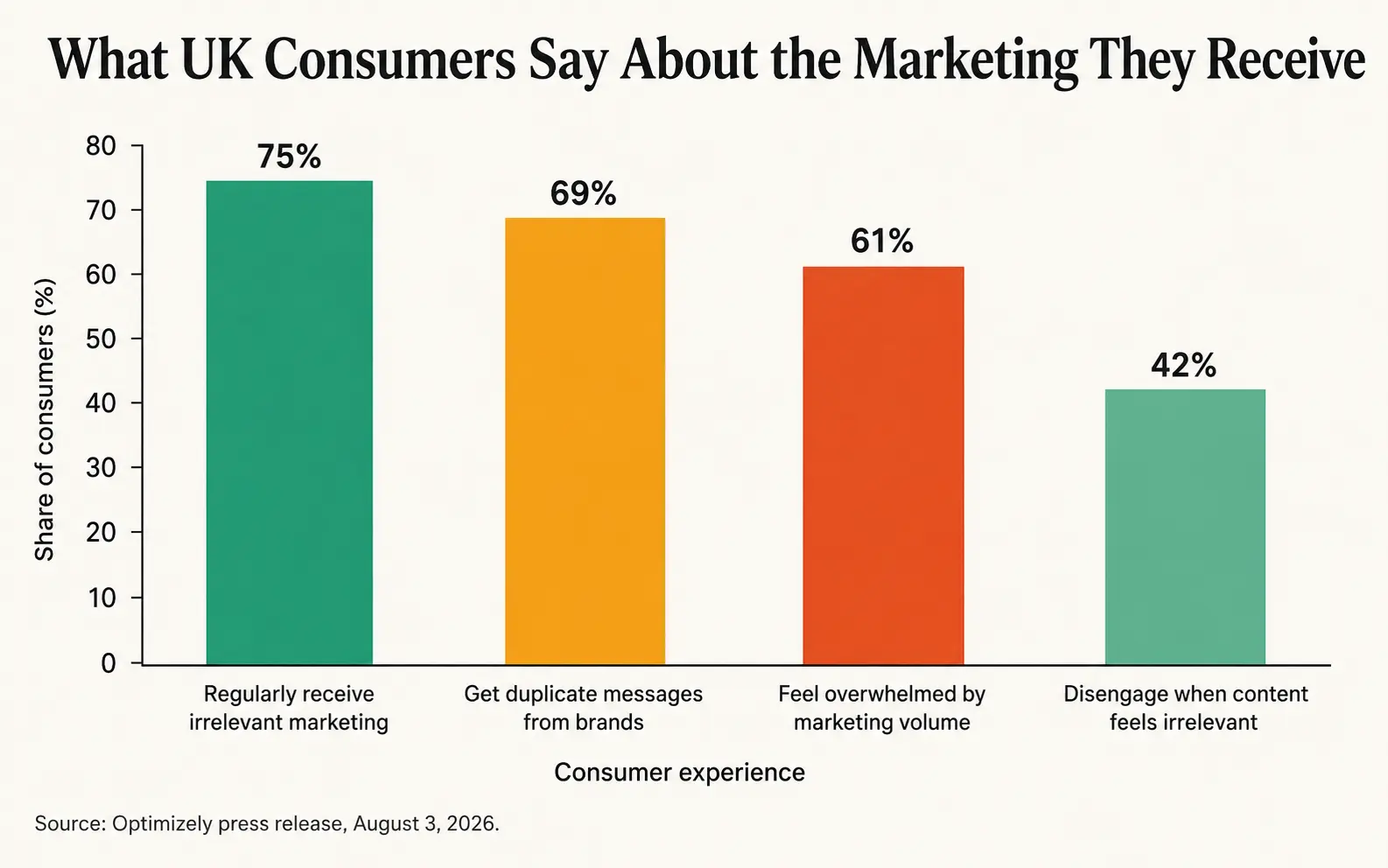
Here’s why that’s genuinely good news for a small business willing to hear it: this isn’t a story about AI failing, it’s a story about volume losing to specificity. While bigger competitors flood the same channels with AI-generated sameness, a business with a real, specific story to tell has a widening opening to stand out, not by producing more, but by producing something a generic prompt couldn’t have written for anyone else. That’s the actual opportunity behind this week’s data, and it’s the honest edge strategic storytelling has over AI content made at scale.
Does More AI Content Actually Build Your Story, or Just Add to the Noise?
The real question this data raises isn’t whether to use AI for marketing content. Most small businesses already do, and that’s not going away. The question is whether the AI tool in use is helping build something distinct, or just helping produce more of what Optimizely’s research says consumers are already tuning out.
That distinction is easy to miss because both paths look identical from the outside: a business posts more, emails more, and publishes more. But content built from a real story, an actual customer moment, a founder’s specific reason for starting, a detail no competitor shares, reads differently than content built from a generic prompt asking for “a social post about our summer sale.” Consumers can feel the difference even when they can’t name it, which is exactly what 42% disengaging on irrelevant content actually measures. Social Scion AI’s own view on this, covered in more depth in Humanized Storytelling: Why Your Business Isn’t on ChatGPT, is that the tool was never the bottleneck. The story was.
Jasper, Copy.ai, and ChatGPT, Compared for Strategic Storytelling
These three AI writing tools were cited via theresanaiforthat.com to confirm they’re real and active, verified against each company’s own pricing page for cost claims, then reviewed against G2 for actual user sentiment, evaluated specifically on whether each one is built to protect a consistent, distinct brand voice at scale, or whether it’s built mainly to produce more generic content faster, since that’s the real test strategic storytelling has to pass that a generic AI draft doesn’t.
| Tool | What It Actually Does | Reviewed Strengths / Limitations | Pricing |
|---|---|---|---|
| Jasper | AI marketing platform built around a “Brand Voice” and knowledge layer, trained on a business’s own tone and style guide so output stays on-brand across a team | Listed on theresanaiforthat.com; G2 reviewers praise it for content that actually sounds on-brand rather than generic, but a documented 2025 pricing overhaul left some longtime users facing cost increases of 300% or more without being grandfathered into old rates | Jasper’s own pricing: Pro $59 to $69/mo per seat, Business plan custom-priced |
| Copy.ai | Originally a content-generation tool, now repositioned as a broader “GTM AI” workflow platform for sales and marketing automation, with content creation as one piece of a larger system | Listed on theresanaiforthat.com; G2 reviewers rate it 4.7 out of 5 and praise its ease of use, but note that the deeper workflow and brand-voice features are gated behind higher-priced tiers | Copy.ai’s own pricing: Chat plan $24 to $29/mo, Growth tier starts at $1,000/mo for larger workflow automation |
| ChatGPT | General-purpose AI assistant, not built specifically for marketing or brand consistency, capable of drafting anything from a single social caption to a full campaign outline on request | Listed on theresanaiforthat.com; G2 reviewers praise its versatility and brainstorming value, but flag that it can produce generic or occasionally inaccurate output that needs a real person to verify and rewrite for brand fit | OpenAI’s own pricing: Free tier available, Plus $20/mo, Pro tiers at $100 to $200/mo, Business from $20 to $25/seat/mo |
Jasper is the tool most deliberately built around the actual problem Optimizely’s research surfaced, its Brand Voice and knowledge-layer features exist specifically to stop output from drifting into the generic sameness consumers say they’re tired of, though that consistency comes at a real, and recently volatile, price. Copy.ai’s shift toward broader workflow automation means brand-voice consistency is no longer its core pitch the way it once was. ChatGPT remains the most flexible and lowest-cost starting point, but its own reviewers confirm what the data implies: without a person actively shaping it toward something specific, its default output tends toward the generic middle. None of these tools decide what a business’s story actually is, that’s a strategic question before it’s a software question, which is exactly where Social Scion AI starts every engagement.
How to Practice Strategic Storytelling Without Slowing Down
A small business doesn’t have to choose between using AI and having a real story. The habits below keep both true at once.
- Feed any AI tool your actual story details before asking for content, a specific customer’s words, a real number, a founder’s actual reason for starting, not just a topic and a tone. Generic prompts produce generic output regardless of which tool is used.
- Set up a brand voice profile if the tool offers one, and keep it updated. Jasper’s Brand Voice feature exists for exactly this reason, and even a simple written style guide fed into ChatGPT or Copy.ai closes most of the gap.
- Read AI drafts for what’s missing, not just what’s wrong. A grammatically clean draft can still be a generic one; the fix is usually adding one true, specific detail no competitor could copy.
- Track duplicate or overlapping messages across channels, the same 69% of consumers who report getting duplicate content from brands are a real signal to check whether email, social, and ads are all saying the same generic thing in slightly different words.
- Treat volume as a means, not the goal. Optimizely’s own research found 60% of marketers launch campaigns without the time or data to properly optimize them; publishing less, but with more of a real story behind each piece, is often the more strategic move, the same principle covered in Why Visual Storytelling Is the Real Growth Lever for Small Business.
Frequently Asked Questions
Is AI-generated marketing content actually hurting my business?
Not by itself. Optimizely’s research points to a volume-versus-relevance problem, not an AI-versus-no-AI problem. Content built from a real, specific story performs differently than generic AI output, regardless of which tool wrote the first draft.
Which AI tool is best for keeping a consistent brand voice?
Jasper is built most specifically around this problem, with a dedicated Brand Voice and knowledge-layer feature, though its pricing has shifted significantly for some users. ChatGPT and Copy.ai can both work well if fed a clear, specific style guide and real story details up front.
What does “strategic storytelling” actually mean for a small business?
It means the content a business puts out is built from something true and specific to that business, a real customer story, a founder’s actual reason for starting, a detail a competitor couldn’t reuse, rather than a generic prompt about the industry or the season.
Why are so many consumers saying marketing feels irrelevant right now?
Optimizely’s August 2026 research ties it directly to AI-driven content volume outpacing the data and strategy needed to make that content actually relevant, 60% of the marketers surveyed admitted they launch campaigns without enough time or data to optimize them first.
Do I need to stop using AI tools to fix this?
No. The fix isn’t using AI less, it’s feeding AI more of what makes a business’s story specific before asking it to write. The tool isn’t the variable that matters most, the story behind the prompt is.
So, What for Small Business Owners
Optimizely’s August 2026 research confirms something worth taking seriously: AI has made it easy to publish more, but that volume is actively wearing consumers down rather than winning them over. Jasper, Copy.ai, and ChatGPT are all capable tools, but none of them can supply the one thing that actually separates a strategic story from more noise in the feed, a specific, true detail that belongs to one business and nobody else. The businesses that stand out from here aren’t the ones publishing the most. Strategic storytelling means being the ones with something real enough that repeating it never gets old.
Your Next Step
Plenty of businesses have done genuinely good work for years and still sound like every competitor’s AI-written caption, not because the work isn’t real, but because the story behind it has never been pulled out and put into words anyone else could recognize as unmistakably theirs. Social Scion AI starts by locating that story first, the Locate phase of the LEADS framework, before any content, AI-assisted or otherwise, gets written. Get your Free Film and find out what your story sounds like when it’s actually the thing being told, not just the topic being filled in. Your story works while you work.


0 conversations