|
Key takeaways
|
The buyer is not asking for a technology montage
An MSP prospect rarely needs another video that says secure, reliable and proactive over stock footage. The buyer is trying to reduce uncertainty. What can fail? What changes after the MSP is engaged? How does delivery work? What proof can be trusted? What happens after the buyer raises a hand?
AI video for IT services works when each asset removes one layer of that uncertainty. It fails when visual polish outruns technical truth. A cinematic outage scene may attract attention, but if the recovery claim is vague, the terminology is wrong or the evidence is invented, the same video weakens trust before a sales call.
The practical answer is a five-part buyer-trust series. Each video has one job, one approved proof source and one next decision. Together, the series behaves like a guided conversation rather than a compressed company brochure.
Current context: On Sep 23, 2026, AWS published a technical pattern for asking natural-language questions of video using Bedrock, Rekognition and Transcribe. The example shows that video is becoming searchable operational material, not only a viewing format. For MSP marketing, the useful implication is narrower: every buyer-facing video should make its claim, proof and next question easy to retrieve and verify. This is baseline context, not a five-day news hook.
What AI video for IT services actually means
AI video for IT services is the use of AI-assisted scripting, image or video generation, editing, voice, captioning and versioning to explain an MSP or technology service to a business buyer. The subject is still the service and the buyer decision. AI is production capability, not evidence. The MSP supplies the real method, approved proof, constraints and accountable point of view.
This differs from a generic AI ad because the video must survive technical scrutiny. It also differs from a product demo because an MSP sells an ongoing service relationship, not a single interface. The content has to explain operating risk, delivery behaviour and proof without exposing client systems or implying guarantees the provider cannot support.
The myth: one polished explainer can do every job
A single hero video can introduce the firm, but it cannot carry every buyer from unfamiliarity to trust. Business owners, finance leaders and technical evaluators arrive with different questions. When one video tries to dramatize risk, explain the service, prove results and ask for a meeting, every section becomes thin.
CrestPoint Marketing makes a useful category-level point: complex B2B services are easier to understand when one short video answers one question. ClearCutVideos similarly presents different B2B technology formats for launches, sales enablement, trade shows, technical demos and integrations. Both are provider claims and examples, not independent performance proof, but they reinforce the same principle: choose the job before the format.
The five-question buyer-trust series
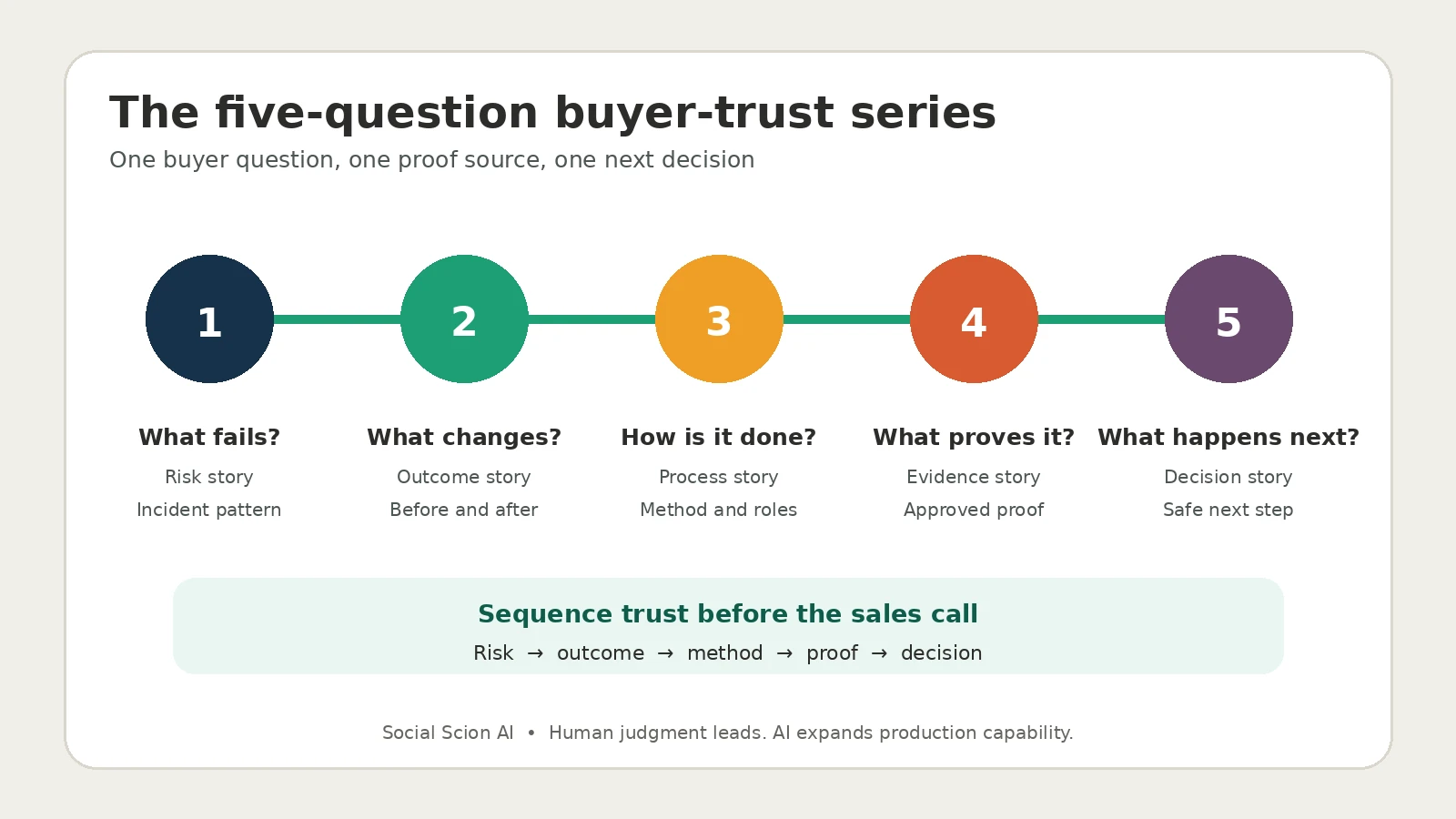
Figure 1. The five-question buyer-trust series maps each buyer question to one story job and proof source.
|
Buyer question |
Story job |
Proof source |
Useful format |
|---|---|---|---|
|
1. What fails? |
Make the cost and consequence concrete. |
Approved incident pattern, public advisory or anonymized scenario. |
30 to 45 second risk story. |
|
2. What changes? |
Show the better operating state. |
Documented process change, service standard or workflow. |
Before-and-after explainer. |
|
3. How is it done? |
Make delivery visible. |
Runbook stages, roles, escalation path and cadence. |
Animated process or whiteboard. |
|
4. What proves it? |
Replace broad claims with evidence. |
Client-approved case fact, test, audit artifact or demonstration. |
Proof story or annotated test. |
|
5. What happens next? |
Reduce first-step friction. |
Assessment scope, inputs, boundaries and output. |
Decision guide with one next step. |
1. Start with what can fail, without selling fear
The first video earns attention by naming a business consequence the prospect recognizes: a stalled order flow, an inaccessible file share, a failed recovery test or a delayed client response. Avoid anonymous attackers and red warning screens. Show the operational tension, who is affected and why preparation matters.
Use a public advisory, a generalized incident pattern or an internal subject-matter explanation approved for marketing. Never imply that a depicted event happened to a client unless it did and permission exists.
2. Show what changes in the buyer's working day
The second video should not promise perfect uptime. It should show a credible improvement: clearer ownership, a tested recovery sequence, defined escalation or faster access to the right information. The visual change must track a service change the MSP can actually deliver.
A GTA MSP might show a retail owner moving from an improvised spreadsheet and unanswered questions to a documented recovery plan, named contacts and a scheduled test. The proof is the process, not a fictional percentage.
3. Explain delivery in human language
The third video turns the service into a visible method. Show the handoffs that matter: discovery, inventory, priorities, remediation, testing and review. Technical depth can sit in a linked resource. The video needs enough precision to reassure a technical evaluator without becoming a tool catalogue.
Animation, screen recording or AI-supported visual development can reduce production burden. A subject-matter expert should review every label, sequence and claim. If a platform is shown, use real approved footage rather than fabricated UI.
4. Let proof carry the trust
The fourth video answers the hardest question: why should the buyer believe this provider? Useful proof may include an approved customer quote, a recovery test excerpt, a documented before-and-after process, a certification with accurate scope or a repeatable demonstration.
Proof is not a dramatic claim. If evidence is partial, say what was tested and what was not. If client approval is unavailable, use a transparent demonstration or public scenario.
5. Make the next step smaller and safer
The final video should explain the first commitment, not force a full proposal. What information is needed? What will be reviewed? What will the buyer receive? What remains outside scope? A clear assessment feels more credible than a vague promise to transform security.
When the sequence is complete, the sales conversation starts with shared context. The buyer can ask better questions, and the MSP can spend less time repeating the same broad introduction.
Choose the format by the evidence you have
|
Format |
Best use |
Evidence requirement |
Main risk |
|---|---|---|---|
|
Expert-led camera |
Point of view and objection handling. |
Named expert with approved message. |
SME becomes the entire content system. |
|
Custom animation |
Architecture, workflow and invisible concepts. |
Reviewed script and diagrams. |
Simplification creates technical error. |
|
AI cinematic scene |
Human consequence and memorable context. |
Real service truth behind every moment. |
Spectacle implies events that never happened. |
|
Real screen or test |
Process proof and demonstration. |
Approved environment, redaction and safe data. |
Sensitive details or fake UI. |
|
Hybrid sequence |
Human explanation, process and proof. |
One source brief and clear approvals. |
Inconsistent voice across formats. |
Choose expert-led video when judgment is the proof. Choose animation when the service is invisible. Choose a real screen or test when observable behaviour is the proof. Use AI cinematic scenes only when they illustrate a truthful consequence or analogy. A hybrid sequence is worthwhile when one format cannot answer the buyer question without losing clarity.
A seven-step production method for MSP teams
- Choose one buyer segment. Name the primary viewer, such as an owner, operations lead, finance lead or technical evaluator.
- Collect the real questions. Use discovery calls, proposal objections, service reviews and support conversations.
- Assign one story job to each question. Map it to risk, outcome, method, proof or decision.
- Attach an approved proof source. Record the policy, test, process, public advisory, permissioned evidence or demonstration.
- Select the least complicated truthful format. Use expert, animation, real capture or AI-assisted scene only when it makes the answer clearer.
- Run a trust review. An expert checks claims, a privacy owner checks data and a brand owner checks voice and disclosure.
- Publish as a sequence and learn. Place videos where questions arise, then track reuse and the buyer questions that follow.
The 15-minute buyer-question audit
Use this exercise before buying a tool or briefing production. It creates a defensible first series from evidence the MSP already has.
- Write the five questions prospects ask most often before agreeing to a discovery call.
- Label each question risk, outcome, method, proof or decision.
- For each question, name one source a reviewer can verify. Mark unsupported answers [NEEDS SOURCE].
- Choose a format only after the evidence is attached.
- Define the next action for each video: continue, open a resource or request a safe assessment.
Prompt starter: Turn the approved buyer question and source material into a 45-second video outline with tension, a plain-language answer, one evidence moment and one next step. Do not invent names, quotes, dates, metrics, motivations, customer details or outcomes. If evidence is missing, mark it [NEEDS SOURCE] instead of filling the gap.
When to stay manual and when AI becomes worthwhile
Stay manual when the message is still unstable
If the service definition, proof permissions or buyer segment are changing every week, a notebook, slide and expert review are enough. Automating an unclear message produces inconsistent content faster.
Use specialist tools when one production bottleneck repeats
Captioning, rough storyboards, voice cleanup, cutdowns or visual ideation can justify a specialist tool when the same task slows every video. Buy for the repeatable bottleneck, not the longest feature list.
Use a broader platform when governance matters more than novelty
A larger system makes sense when multiple people need asset history, approval, version control, safe source access and repeatable brand rules. Ask where files are stored, how client data is handled, whether outputs can be edited, who owns usage rights and how generated material is disclosed.
For a wider view of production risk, see AI Video Limitations in 2026. For platform-change context, see AI Marketing Videos After Google Omni. The human trust principle is developed in Humanized Storytelling for Business Visibility.
Common mistakes that weaken buyer trust
- Starting with the tool. The buyer sees novelty but learns little about the service.
- Using fear without operating detail. A dramatic outage feels manipulative when the video never shows preparation.
- Treating benefits as evidence. Replace secure, proactive and reliable with an approved process, test or standard.
- Fabricating interfaces or outcomes. Use real capture, diagrammatic abstraction or a clearly illustrative scene.
- Sending every format to every channel. Distribution should follow the buyer question.
- Measuring views alone. Judge sales reuse, useful questions, resource clicks and assisted movement.
Questions MSP owners ask before starting
How long should an IT-services video be?
Long enough to answer one buyer question without adding a second job. Many focused explanations fit in 30 to 90 seconds.
Does an MSP owner need to be on camera?
No. Camera-optional does not mean human-optional. Use an expert voice, approved proof, real process capture, animation or cinematic illustration.
Can AI write the technical script?
AI can draft structure, but an accountable expert must approve terminology, scope, claims and omissions.
What proof is safe to use?
Use evidence the organization owns or has permission to publish. Redact sensitive data and define test scope.
Should the series promote every service?
No. Build around one buyer decision, such as recovery planning or managed security readiness.
What should the team measure?
Track sales reuse, buyer questions, resource opens and clearer next steps. Treat reach as context.
Social Scion stance
The most useful AI video for IT services does not make the MSP look futuristic. It makes the buyer feel better informed. The real delivery method, client-approved proof and technical judgment lead. AI expands how that truth can be visualized, versioned and distributed.
That is the Story OS advantage: one evidence-backed narrative source can produce an ATTRACT risk story, an ENGAGE process explanation and a CONVERT proof or decision asset without changing the underlying truth. The system reduces reinvention while keeping human accountability visible.
Want to see what your business looks like when the right story is found first? Get your Free Film.
Methodology and sources
This guide uses the approved M01 opportunity brief, verified public provider examples and official AWS material. Provider claims are treated as examples rather than independent outcome evidence. No hands-on tool testing or customer performance claim is presented.



0 conversations